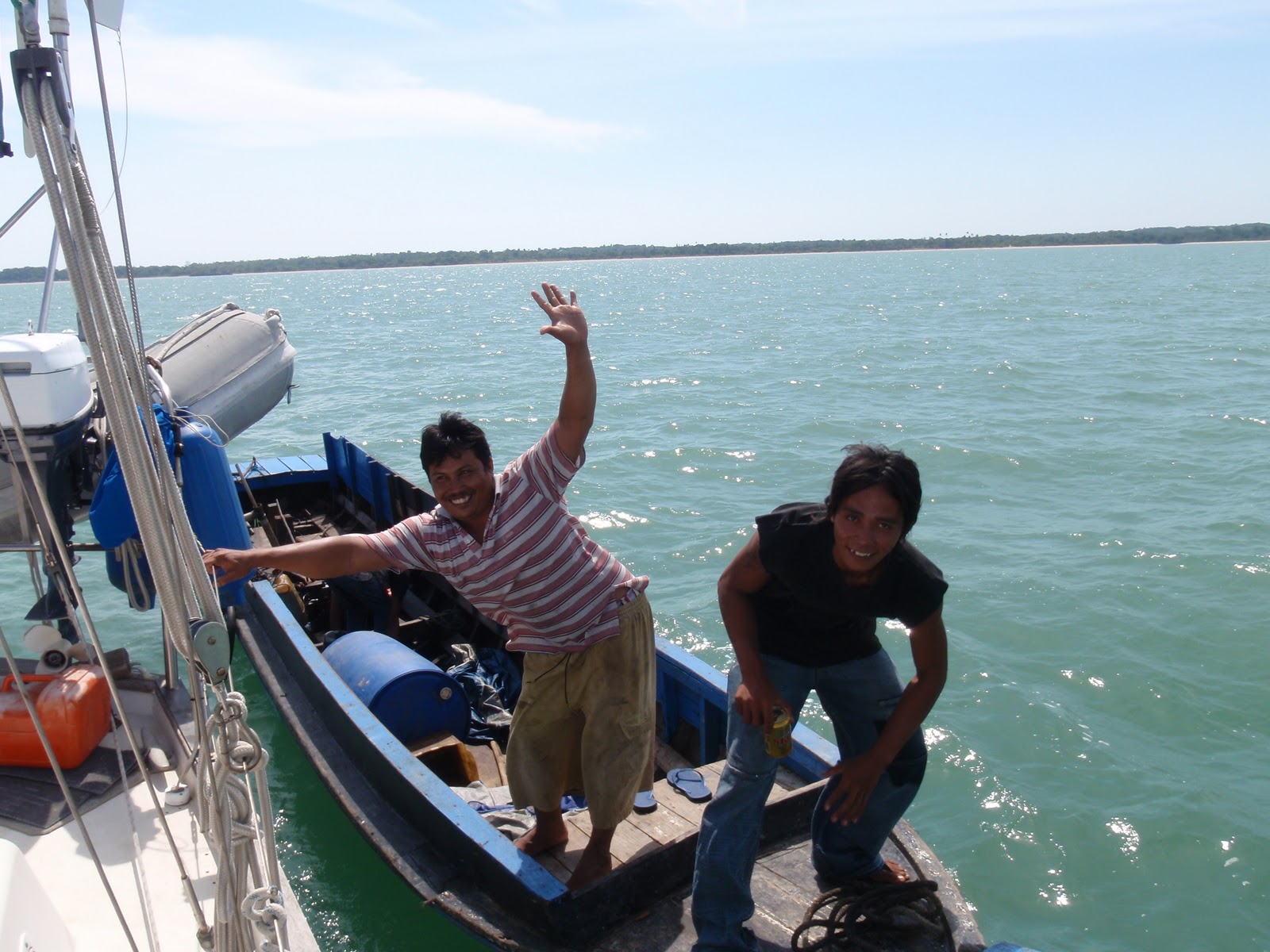
Showing posts with label trade. Show all posts

23 April 2012

10 Questions for Happy Monster

hm1 Hans and Dory sail on Happy Monster, a 36 feet Najad made in Sweden. The inside is not original Najad, but made by the first owner. They bought the boat in 2002 and left Holland in May 2005. They crossed the Atlantic and the Pacific and arrived in 2007 in New Zealand. There their plans to sail around the world changed and after a year working in NZ they continued sailing up and down in the Pacific. You can learn more about them on their website.

What are some of your favorite pieces of gear on your boat and why?

Wendy, our wind vane. She is a Dutch made Bouvaan and steers most of the time. Our new hard dodger we put on in New Zealand, the lights underneath and the solar panels and hand grips on top are very helpful. The Spectra water maker with Z-brain now two years old and never failed. The Z-braine keeps it clean so that we don't have to flush or pickle when we don't use it.

What is the next piece of gear you would add to your boat if it were free?

An AIS transmitter, so that other ships with AIS will always see you. (if they look) Of course there are some fancy chart plotters with worldwide maps, we really don't need them.

What mistakes did you make in your first year of cruising?

Not knowing we had to grease our rudder shaft often.

What type of watch schedule do you normally use while offshore?

We do a 3 hour watch starts at seven. Every three hours we change, so we have both two time three hours of sleep in the night, on the day we sleep mostly both two times an hour.

hm2 Do you have any specific advice for couples cruising?

Start with loving each other very much and you have to like to be together 24/7. Try to do things together as much as possible so that both know how things work.

What is a tip or a trick you have picked up along the way?

Never be lazy if it comes to prevent accidents, like reefing, taking your shoes out of the dinghy while you still can (next morning they were gone). Learn to be patient if you deal with customs and immigration. It takes often a lot of time and if you plan that it will cost you a day, you are feeling good if it is faster.

What is something about the cruising culture you like and what is something you dislike?

We like the fact that the cruisers world is one big family, you all do the same and you help each other with whatever problem. We like the freedom we have and the friends we make. We don't like the goodbye's, and we have to say that a lot.

Have you found "trade goods" to be useful on your cruise? If so, what kinds?

Before we left we had made many lighters, balloons and t-shirts with our Happy Monster on it and they still are very good give aways. We also ordered some inflatable globes to give away on schools and we point out on these globes the trip we made. For the rest we have the usual pencils, flashlights etc to trade or give away.

Where was your favorite place to visit and why?

We have visited many many favorite places. Sometimes it is nature and sometimes it is the people that makes the place special. We are now in Fiji and we think that as well the people as the nature as the climate is so good that we call this our most favorite.

What question do you wish I would have asked you besides the ones I've asked you and how would you answer it?

What is a good reason to go cruising?

You can sleep in your own bed and cook your own food while you have a new backyard every time after sailing. You have the one million view on a very low budget. If you want it just do it.

19 September 2011

10 Questions for Pelican

pelican2Jonas first started cruising when he was 24, on a 32 ft Pearson Vanguard, "Tabasco". He completed a two year coastal cruise from California down to Costa Rica and back in 1995-1997.  In 2006, he found Pelican, a Pearson Alberg 35, in Seattle.


He says: I left on what turned out to be a nearly five year single handed circumnavigation.  The route was Mexcio, South Pacific, refit in New Zealand, Melanesia, north of Australia, up to the Andaman side of SE Asia, Sri Lanka, East Africa, Cape Agulhaus, Brazil, north coast of South America, Caribbean, Panama Canal and back to Mexico.  In my homeport of San Francisco I am an active member at the Cal Sailing club in Berkeley where I regularly volunteer teach sailing. 

You can learn more about his circumnavigation on his website.

Have you found "trade goods" to be useful on your cruise? If so, what kinds? Yes, in some areas they can still have value.  Cell phone digital cameras are popping up everywhere but a printer with photo quality paper to actually print the pics out (especially family portrait photos as gifts) is great to have.    22 caliber bullets in the Marquesas and you will be treated like a king.  Plain old aluminum oxide sandpaper in Tikopia got me praise from the chiefs!  Cheap dive masks in any underdeveloped island community.

What are your impressions of the cruising community? Too much money in the cruising scene...  The go now and go modest philosophy isn't popular at all.  There is an informal club out there called "under 40".  It isn't just about being out cruising while under forty years of age but also having less than forty thousand US invested in the boat.  This is rarer than being younger.  When you came across another member, the "club" is always a topic of conversation as it is pretty rare to meet young cruisers on a budget. The community makes one feel that cruising is not a lifestyle to get
away from the "real world" as much as it is a reward for having done well in it...

pelican3What is a tip or a trick you have picked up along the way? When you get to an anchorage off a village and you need to figure out where to put your dinghy, instead of locking it up or paying money for someone to watch it, loan it to a local that wants to go fishing. Initiating that sort of level of trust and sharing will open a lot of doors and in a small village everyone knows everyone else.

What piece(s) of gear would you leave on the dock next time? Why? Storm trysail and separate track if single handling on a small boat. The reality I found is that by the time you want to set it up, the motion of the boat is so much that it is unsafe to set.  A deeper third reef in the main is a better solution.

How often have you faced bad weather in your cruising? How bad? The saying that it is much safer offshore than close to land in a blow is really true.  I was in an anchorage in the San Blas when a strong squall ripped through in the middle of night.  It was literally airborne dinghies, a lot of screaming on the VHF, and so much rain you couldn't see who was dragging and who wasn't.  Luckily most squalls don't last long so no boats were lost.  Some boats scrapped against the reef and there were destroyed windlasses.  The same squall offshore would have been nothing serious.

What mistakes did you make in your first year of cruising? I made the mistake of not taking enough chances. During my first season through the South Pacific, the lagoon passes with descriptions like  "outbound currents up to 9 knots", or "not visited by author" or
"even the locals respect it" were skipped.  I chose destinations that had reliable charts, that had facilities and were not too tricky to get in or out of.  I should have done a bit more of the opposite... In the trades, you only get one downhill pass so you need to make it count.  Get over the fear of losing the boat and you will see places few do.

How do you learn about the rules and regulations of your next port of call before arriving or do you just arrive and find out? I remember being in Chagos when the Seychelles were surrounded by Somali motherships.  About half the cruising boats in Chagos that were originally west bound decided to not go any farther and instead went
back to Asia.  A handful of boats that were bound for Madagascar, including myself, took a huge detour to go south of the Salha de Maya Bank and ended up in Mauritius or Reunion.  From there we made landfall at Saint Marie on the windward side of Madagascar.  The entire exchange of information from rules and regulations of checking in to the latest on locations of the recent pirate attacks was handled by SSB and nets that were set up by boats in the area.

How would you recommend that someone prepares to cruise? Most people who dream of cruising have usually only daysailed in pleasant conditions and need to have a major reality check before taking the plunge.  At my homeport of San Francisco it is consistently
25 knots and 7 to 8 foot seas right outside the Golden Gate Bridge.  I recommend all local wanna be cruisers to leave the protection of the bay, find a spot outside the shipping lanes and heave to for 48 hours
before coming back in the bay.  If this sounds like a crazy and senseless masochistic sort of torture session then you aren't ready for cruising.

pelican1 Is there a place you visited where you wish you could have stayed longer? Being single, full of youth and out cruising on your own boat was a place that I could have stayed a little longer!

What question do you wish I would have asked you besides the ones I've asked you and how would you answer it? 

Have you ever wanted to quit cruising while still in the midst of doing it? 

Yes, a couple of times.   It got miserable enough that I ended up making a vow to never set foot on a boat or go to sea ever again.  The worst loneliness, extreme physical discomfort, and plain old gut wrenching fear can get to you. These are not true tragedies though and can be put into perspective.

I think those low moments when it doesn't seem like it is worth it happen to anyone who has been out long enough. The feeling always passed...

02 May 2011

10 Questions for Sarana

sarana1 Eric & Sherrell have been cruising since 2003 aboard Sarana, a Pacific Seacraft / Mariah 31hailing from Seattle, WA, USA. Over that time they have traveled through Alaska, Canada, from the US down to Ecuador and everywhere in between. You can read more about their journey on their website. They say: We write electronic cruising guides for Central America that covers dozens of areas that have been completely unexplored by previous guide books.  Our Central American guide books are here and we have some free guides including the first guide ever written to Pacific Colombia. Also we forgot to mention our two cats (Jezebel and Jordan) as part of the crew...but they don't really crew very much.

What is something you think potential cruisers are afraid about that they shouldn't fear? And what is something potential cruisers don't worry about that perhaps they should?
We were at first worried about finding fresh food and water when we left developed areas for more remote locations.  Even if you don't have refrigeration or a watermaker (like us) you'll always find at least basic produce and fresh purified water.  And we've been surprised how much water we can catch during a rainstorm.  Naturally you'll need to practice conserving water use if you don't have a watermaker to extend your range.  We average 1 gallon per day per person.

Also we worried about breaking something important.  As it turns out things always break.  Worrying about it doesn't help.  We try to keep everything as simple as possible so that we can make our replacements and keep going.  There are a lot of talented mechanics and machine shops out there to help you in a pinch.

What (if anything) do you wish someone had told you before you started cruising?
Don't read all those sea disaster books.  They scare you more than help you.

What piece(s) of gear would you leave on the dock next time? Why?
On a small boat this isn't usually a problem.  You don't have much space for “extra” stuff.  But if we weren't sure about something we would try to bring it as you can easily trade or sell it to other people along the way.

In your own experience and your experience meeting other cruisers, what are the common reasons people stop cruising?
Common reasons the people we know who quit:
1. Don't like cruising.  It can be laborious, uncomfortable and lacking stimulation provided by the rat-race.
2. Need money.  Big expensive boats, poor budgeting, expensive equipment failures, too much partying, providing for kids are some of the reasons cruises have a limited duration.
3. Family needs.  Aging parents who need care.  Pull of new grand children draw grandparents home.
4. Ego collapse.  The work environment provided immediate feedback for your work.  After decades of work=rewards it can be difficult to adapt to work=nothing.  Whether people liked their jobs or not, the sudden
lack of any type of acknowledgment (money) can be difficult.  Many people return to their careers.
5. Medical problems.  Sometimes people have physical issues that develop during their travels and they can no longer cruise.

We were shocked to discover that in this age of jet travel few people live on their boat year round.  The majority of people we know fly “home” once a year.  Perhaps this helps relieve some of problems that
has caused others to quit.  There are a lot of cruisers that only live on their boats for part of the year.

In your first year of cruising, what transitions did you find the most difficult?
Training our family that we can not always be available took many months if not years.  The internet has helped make us more available however this is still an on-going problem.
Sadly we lost a few friends because they were unwilling to accept our new lifestyle whether through lack of understanding or envy or whatever.  They quickly drifted away.

Are you attracted more to sailing itself or cruising-as-travel and has that changed over time?
Eric:  I started off racing.  So I love sailing especially in a competitive fashion.  However I wouldn't want to just sail round and round like Benard Motissier.  I love going new places, learning new languages, and experiencing different cultures.  In a way I'm a xenophile.  I am much less interested to go someplace I've been than to go somewhere new.

Sherrell:  I love traveling and experiencing new cultures especially through the small local villages that I would otherwise never experience without a sailboat.  Sailing between these places is an added bonus.

What is something about the cruising culture you like and what is something you dislike?
Sherrell:  I like the independent minded and spirited individuals who make up this culture and the unique things they bring to my life's experience.  What I don't like about the cruising culture is in large cruising populations such as in Mexico there tends to be cliques with group activities.  They tend to create an insular world and don't mix with locals or learn the language beyond “Una mas cerveza por favor.”

Eric:  There are a lot of knowledgeable people who are willing to help out if you are stuck on a problem.  The downside is there are a lot of knowledgeable people who are too willing to help out if you are stuck
on a problem.

sarana2 What has been the most affordable area to cruise and the most expensive? What was affordable or expensive about each area?
We've been able to stick to our budget even in the USA, but you have to make sacrifices like not eating out or staying in marinas.  This goes true for other countries too.  You can spend lots of money even in the cheapest countries.  A better strategy for controlling your budget is to just live within your means and spoil yourself once in a while.  Saying that, we have found all of Latin America in general to be inexpensive with some variations between countries.

Have you found "trade goods" to be useful on your cruise? If so, what kinds?
We haven't traded anything other than technical skills for services. However there are some very remote villages where gasoline, d-batteries, school supplies and some clothing are appreciated more than currency.  These places are very few as most of Latin America is fairly well industrialized.

What question do you wish I would have asked you besides the ones I've asked you and how would you answer it?

EricWhat is one piece of advice you have to people who want to go cruising?

Stop making to-do lists.  Go use your boat as if you are cruising.  Use the crap out of it.  Your priorities will do a 180 degree flip as you find more important things to worry about than the color of your sail covers.  Practice staying on a budget, anchoring out, repairing everything yourself, using your alternative energy, using your navigation gear, your running rigging and all the little things of living on a boat that you can't do while sitting at a dock. Forget the books, websites, forums, etc. and get some personal time with your boat.  It will do a world of good to help you filter out the noise and find the important things in your life – even if that answer is that you don't like cruising.

28 March 2011

10 Questions for Location

location3 James “J” Mills cruised aboard Location, a Calatline 470 hailing from Newport Beach, CA, USA from 2006 until 2010. In October 2006, with his wife LeDean, his dog “Escrow”, and two friends Terry & Jim, he sailed off for Mexico with the 2006 Baja Ha Ha. LeDean, Escrow, and “commuter cruised” the Sea of Cortez, primarily around La Paz for the next two and a half years. In March 2009, he set out single-handed and sailed from La Paz to Conception Bay, back to La Paz, and then across the Sea to Mazatlan, and from there south to Banderas Bay, Manzanillo, and finally back to Newport Beach in June 2010. Interested readers can find articles, essays, and stories of his years of cruising at his website, view his photo page or contact him via facebook. He has been an avid sailor, scuba diver, skier, entrepreneur, workaholic, life-seeker, most of his life. In 2006, after a long business career, he took a sabbatical to pursue his dream of sailing around the world, and to focus on becoming a writer. He is currently writing two books based on his sailing experiences.

What is something about the cruising culture / experience you liked and what is something you disliked?
Wow… there was so much that was positive, and wonderful, and amazing, and so little that I would describe as negative, at least in hindsight.

Right from the beginning, with the Baja Ha Ha in 2006, there was always a great feeling of camaraderie among the cruisers that we encountered throughout our travels. One of the things that always amazed me was how common our experiences were, or would become. If you stay out long enough, you’ll experience all of the good things, and most of the bad things that cruisers go through eventually. The VHF Cruiser Nets in the more popular ports are a great resource. If you start talking with other cruisers, and listen and learn from their experiences as you go you will certainly enhance your experience and in particular learn how to handle the rough spots more easily. When cruisers got into trouble, weathered a storm, or some other event, something broke on board, or whatever, the VHF Cruiser Net, or just talking with other cruisers in the marinas and anchorages where we were, almost always led to help and an eventual solution.

My last 18 months were spent single-handed, and that was probably more difficult than I had imagined it would be; not so much the loneliness (because single-handing was a choice), but the “lone-ness”. A lot of the culture is based on “couples” out there cruising, and it’s more difficult I think for a single-hander to bond with the “group”. There seems to be some apprehension from others about why you’re out there by yourself. I have my theories about that, both serious and not. 

Of the changes, choices, and compromises you had to make along the way, which were you happiest and most satisfied about, which do you wish you had chosen otherwise and why?
There were many variables in my life during the four years I spent cruising, too many things that could have been done differently, and it would be easy to have regrets, but I don’t really, and there’s not much that I would seriously do differently, all things considered.

I would have liked to have spent more time further up in the Sea of Cortez, but in between the hurricane season and winter you only have about three months of ideal cruising, so you have to decide how to spend the hurricane season, and whether you want warm water in the winter. My first year out single-handed I left La Paz in March with plans to stay up in the Sea through June at least, and maybe summer in the “hurricane hole” in San Carlos / Guaymas. I got into a gale one night in April near Bahia Conception that damaged my rig though, and after patching things up I had to go back to La Paz to make repairs. I took my time going back and really enjoyed that cruise down the coast of Baja, but it was late June by the time the repairs were complete. I had already spent three summers in La Paz so I decided to head across the Sea to Mazatlan. That summer in Mazatlan was very hot, humid, and uncomfortable, and I think I would have preferred to be in La Paz, but I was also very happy that I had not ended up in San Carlos, as I had planned, because it got hit by a serious hurricane that year. Still, my boat did sustain some damage from a hurricane that grazed Mazatlan, and a lightning strike. But if I hadn’t been there then, I might never have gotten over to that side of the Sea.

Ultimately, you never know what to expect. You just have to weigh all your options, evaluate the risks and rewards, and then step out there and do it, and deal with whatever comes your way. Most of it will be incredibly good.

location Describe a perfect cruising moment that will make cruisers-to-be drool with anticipation.
I don’t think that there is anything “perfect” about cruising (except perhaps some of the sunrises and sunsets, a cold beer over ice sitting under the bimini on a warm afternoon at anchor, a morning swim in clear, warm water, a spinnaker run in ten knot winds and flat seas, a full moon on a quiet night…..OK, maybe a few things!).

One of the more amazing experiences I had was after our second night out, going south on the Baja Ha Ha. We were sailing along the west side of Cedros Island, with our spinnaker up,  in fifteen knot winds and five foot seas as the sun rose, when we were suddenly surrounded by a large pod of grey whales. You could see their blow-spouts erupting all around us. I was up on the bow getting ready to drop the spinnaker in the growing wind and seas, when my wife at the helm yelled my name in a rather panicked mode. I looked back just as a huge whale, coming up behind us, rose up on the surface and then dove beneath Location’s stern with its tail raised, filling the air as if it would swat us from behind, and then disappearing into the sea, very close. We were sailing at nearly nine knots, and this big whale then surfaced right along-side us and rolled over on his side, and kind of waved at us with his big flipper, and I could see his eye looking at me. He was as long as we were, and he rolled under the water and the boat, and then came up on our other side, and took another look, blowing a gust of air and water over us, still moving right along with us in the big seas. We got so excited watching that whale as he watched us, literally no more than ten feet away, pacing us, that we lost the spinnaker and it wrapped on the forestay, which created another whole set of problems. The whale kept pace with us for another fifteen minutes, swimming along our side, diving under us from one side to the next, watching us as we struggled to unwrap the spinnaker sail, and avoid a collision, which was really pointless since the whale had a lot more maneuverability than us at that point. Finally, he swam ahead of us in a sudden spurt of speed and rolled up on the surface again, flashed his huge tail in the air about twenty feet off our bow, and disappeared beneath the water.

Another very truly evocative experience was waking up in Matanchen Bay to calm, warm water, tropical green hills, and golden warm sunlight, after arriving there in a very dark cold night, from a rather difficult 32 hour single-handed passage (made with no instruments or autopilot) from Mazatlan. That was about as “perfect” a feeling of peace and transition as I have ever experienced. Setting off on a passage was always exciting, being short or single-handed was always a challenge, arriving at a destination was always wonderful. 

What did you miss about living on land?
Provisioning was always a challenge. Not the shopping itself or finding what you want so much as the logistics of getting to and from the store. I missed the freedom of being able to just get in my car and go to the store. When we were commuter cruising in the early years, we would drive down to La Paz from Southern California most of the time, so we had a car, and it was relatively easy going back and forth from the marina and town. Later, when I was single-handing, and out on the Sea cruising from one anchorage or port to another, it became more of a challenge; first finding out where you needed to go, and then finding transportation, and handling all of the bundles and bags of goods and groceries. If I needed to go to more than one store, then it usually required more than one trip, which usually meant more than one day.
 
In Mexico the bus systems are pretty good and easy, especially on the mainland. The buses will stop and pick you up or drop you off anywhere along their routes; they run consistently and you seldom have to wait long for the next bus to come by; they are cheap, but comfortable, and usually air conditioned; and riding the bus is a great way to get to know the cities. Taxis give you more freedom, but are far more expensive. Sometimes I would take a bus to the store, but since I had bought so many supplies and couldn’t carry them all, I would have to take a taxi back to the boat. I guess this is fairly common, since there were always taxis waiting outside or near the major stores. 

Did you find "trade goods" to be useful on your cruise? If so, what kinds?
We didn’t take anything with us specifically as a “trade good”, but at times we did barter and trade some of our supplies with local fishermen. Along the coast of Baja in particular, there are isolated little fish camps that the fishermen work out of and live at. These camps are often a long way from civilization, and so the fishermen, some of them with families, have a difficult time provisioning themselves.

Along the coast of Baja between Puerto Escondido and La Paz I came upon one fisherman who approached me at anchor and wanted to trade a couple of lobsters he had yet to catch for a six-pack of beer and fifty pesos. I agreed, and about an hour later he returned with two very nice lobsters for a total price of about 110 pesos or eight dollars.

On my way up the Pacific side of Baja (doing the Bash) I was anchored at Bahia Santa Maria, which is very isolated and hard to reach by both land and sea, waiting for a storm to pass. The fishermen were stranded as well, and a small panga with three men on board came by and wanted to trade either lobsters or fish they had caught for meat. I took two lobsters from them and gave them two cans of Chili Con Carne, two cans of Corned Beef Hash, and two bottles of water in exchange, which amounted to about eight dollars in cost to me. They would have preferred a couple of steaks, but I didn’t have any fresh meat on board then. They also asked for batteries, which they needed for their hand-held GPS and radios.

In Mexico at least, the locals can buy almost anything they want or need, and usually cheaper than we might pay for it, so we typically didn’t have anything onboard that might be a valuable trade good. In the more remote regions of the world, such as the South Pacific and Far East Islands, trade goods would probably be more valuable to have onboard. 

location2 What piece(s) of gear would you leave on the dock next time? Why?
Location was very well equipped when we left the States, and the only things that we didn’t use were probably the two heaters we had stowed away (until my “bash” back up the coast in 2010). We also had a portable ice machine that took up some space in the main cabin, and didn’t get used very much. It was a 110 volt model that required a lot of power, and so we never used it at anchor, and only occasionally while in a marina and hooked to shore-power. Ice was always available in the villages and marinas, and kept well in the freezer, and the freezer also worked well enough to make ice in some aluminum ice-trays that I had, so really the ice maker wasn’t needed.

In your experience, how much does cruising cost?
This really depends on your lifestyle. If you are staying in marinas and eating out a lot, which we did in the beginning in La Paz, then it cost about $1,500 a month for the two of us and our dog. We could have spent more if we had taken a lot of side excursions, but we stuck pretty much to the sea, and cruising the islands.
 
Later, when I was single-handed, and my funds were more limited, I spent a lot less time in marinas, and lived pretty well on about $500 per month, which covered five or six days a month in marinas, two or three meals a week on shore, and all of my food, fuel, and other necessities. Traveling back and forth from the States, boat maintenance while away, cell phone and satellite phone costs, insurance, and occasional boat repairs added more expense. Cruising full-time is cheaper than commuter cruising, because of the extra travel and marina expenses. If everything else is paid for then I would say that a couple can live very well, and experience the local sights in Mexico, on $1,000 a month, cruising and living aboard full-time.

What is the most difficult aspect of the cruising lifestyle?
As I mentioned above, provisioning was probably the most challenging regular chore that we had while cruising. Laundry and making repairs to the boat were also challenging and time consuming chores that had to be done regularly.

Dealing with sudden, and unexpected changes in the weather was probably the most difficult and challenging aspect of cruising overall, especially when I was single-handed. Yes, I always checked the weather, but the weather was not always as predicted, and once you’re “out there”, you’re out there! I went through a sixty knot gale with thirty foot seas on my first single-handed over-night passage, sailing from Puerto Escondido to Bahia Conception; the weather forecast had no clue of it. I weathered numerous late night blows at anchor with winds at thirty to forty knots that just came up with no warning, several “chubasco” thunderstorms along the coast of mainland Mexico, with winds up to seventy knots, and a “weather bomb” in Banderas Bay that smacked the cruising fleet anchored in La Cruz late one night with ninety knot winds and high seas. Location also weathered three minor hurricanes while berthed in La Paz and Mazatlan. All in all, these storms were few and far between, when you consider the four year time frame, but they kicked the @#$%^&* out of both me and my boat, and make you wonder at times what the hell you are doing out there. After you have been through a couple of fifty and sixty knot blows, thirty and forty knot winds don’t seem so bad, and you begin to trust your preparation and get used to the surprises. A couple of good days of fair weather and fair winds, and the storms were quickly forgotten, though the lesson was learned to always prepare for the worst, and relish in the typical calm.

In your own experience and your experience meeting cruising couples, can you convince a reluctant partner to go cruising and if so, how?
Can you?..... Maybe. Should you?.... probably not! If your partner is reluctant then it is probably based on fear, either of what they know or suspect, or of the unknown, or they just plain don’t want to go; leaving friends and family can be difficult. You can’t train, or teach, or learn how to overcome reluctance. It won’t do any good to soft-pedal the experience; basing expectations on the “feel good” articles typical of the sailing magazines will surely turn any reluctance into staunch resistance once the reality of the cruising experience has struck.
 
Cruising is wonderful, exciting, relaxing, invigorating, frightening, marvelous, challenging, mysterious, and life evoking. It is not easy! It needs to be experienced to be appreciated. You can inch into that experience with weekend cruises, and weeklong cruises, and then two week cruises, but you can’t be afraid to experience the bad with the good, and if someone is not open to new experiences then cruising is probably not something that they will ever be comfortable with.

If you are out there full-time then you will surely experience some difficult times. If you are cruising seasonally you can reduce some of that exposure, but not all of it, and the bad will happen along with the good. In my case, I found myself single-handed after two years of commuter cruising, trying to convince my partner of the merits of a worldwide cruise…. It may have been my fault, since I have a tendency to push the envelope, but I don’t think that you can cruise without a certain amount of potential mayhem. I tried, but ultimately it just wasn’t in her, and our good experiences together did nothing to change her reluctance.

What question do you wish I would have asked you besides the ones I've asked you and how would you answer it?
 
Where was your favorite cruising area?


location4 The Sea of Cortez is an amazing cruising area, and I would have to say that wherever I was at the time was my favorite area. La Paz was logistically the most convenient location for commuter cruising from the western US. It is a very friendly and comfortable city that always felt safe and secure, with great restaurants, and a very uncluttered, unhurried, family based ambiance.

Banderas Bay offered the best sailing, and it was not uncommon to sail completely around the Bay without changing tacks just following the typical shifts in the wind through the day. I also enjoyed La Cruz a great deal, with its friendly cruiser community and small town feel, and of course tropical and isolated Yelapa on the south side of the Bay.

Mazatlan was a wonderful cosmopolitan city, very “old Mexico” and cultural, and I particularly enjoyed visiting the Old Town Historical District with its renovated buildings, the Cathedral, and parks, and patio restaurants. It had the best bus system as well, and a great boat yard with very affordable and expert boat services from Total Yacht Works at the Fonatur Marina.

Weather was always a defining element of course. I spent a wonderful two weeks over Christmas anchored in Chacala on the mainland coast north of Banderas Bay. Matanchen Bay and San Blas were sublime, except for the jejennes at night (no-see-ems). And the entire Baja coast and the islands from Bahia de los Muertos to Conception Bay offered the best and most beautiful white-sand beaches and anchorages, and good fishing and diving, with the occasional challenge of a late-night Coromuel wind to keep things interesting.

I could easily have spent another two years on the Sea of Cortez and in Mexico, and still had more to see. Not once did I ever feel unsafe at any place or time while in Mexico, including the many drives we made up and down Baja, and while there are obviously some problems in certain areas of the country they are easy to avoid with a little common sense (there are areas in the US that you just don’t go to either, but the Press doesn’t talk about that!), and I would never hesitate cruising that area again.

28 February 2011

10 Questions for Shibui

shibui Brian & Mary Alice O’Neill have been cruising since 1987 aboard Shibui, a Norseman 447 (47’) hailing from Seattle, WA, USA. From 1987 – 1989 they sailed through the South Pacific to NZ (on different boat which they sold there). From 1992 to 1997 they completed a circumnavigation (Mexico to New Zealand via South Pacific: French Polynesia, Cook Is.; Niue; Tonga; Fiji, New Zealand. New Zealand to Mediterranean via the Red Sea: New Caledonia, Vanuatu, Solomon Islands, PNG, Indonesia, Borneo, Singapore, Malaysia, Thailand, Sri Lanka, Djibouti, Eritrea, Egypt, Israel, Cyprus, Turkey, Greece, Italy, Spain. Atlantic Crossing: Gibralter; Canary Is. to Caribbean. West Coast of Central and North America via the Panama Canal). Since August 2009 they have been cruising Hawaii; Palmyra Reef; Micronesia (Marshall Islands, Kwajalene, Kosrae, Pohnpei, Yap). I caught up with them via email at the end of 2010 in Palau. You can see some of their photos on their web album or contact them via email (svshibui@gmail.com).

What (if anything) do you wish someone had told you before you started cruising?
Can’t think of anything specific. One of the fun things about cruising is learning, whether it be about boat maintenance, navigation, cultures, geography, history.  It’s the best liberal arts education you can get.  Perhaps I would caution people to keep the boat systems simple and have a backup system for everything.

Is there a place you visited where you wish you could have stayed longer?
New Zealand, Turkey and now Palau.  After 7 months of cruising Palau it will be difficult to leave although we are looking forward to our next port of call in the Philippine Islands.

What is your most common sail combination on passage?
Current trip: Reef in main with poled out jib.  We had brisk NE tradewinds on this journey. Generally we have tried to plan voyages where the wind is behind the beam.  Going downwind if the winds are light we fly a traditional chute otherwise we use a poled out yankee.  Going to weather in light air we use a spectra 125 percent.  When the winds get to around 12 knots true, we switch to a 95 percent yankee.  If the winds get to around 20 knots (true) we rig our staysail and get rid of the headsail.  Because we have been in the trades on this voyage we have only had to motor for a few hours.

Over the time that you have been cruising, has the world of cruising changed?
YES!  There are more people out cruising with the advent of GPS and other electronic devices.  Mexico has become much more crowded with sailors and power yachts in the past 20 years.  The Mexican's have capitalized on the yacht boom by building many first class marinas, most of which are expensive.  However, they are fun to visit, we just try and limit how long we stay at a marina.  We hear that Central America is also getting somewhat crowded.  All this said, I think a person can still find many unspoiled parts of the world.  Our present voyage through Micronesia has given us wonderful opportunities to explore remote islands and learn their history and culture.Also, Sailmail and the internet make communication much easier.

shibui2 Describe the compromises (if any) that you have made in your cruising in order to stay on budget
Hasn’t been necessary.

In your own experience and your experience meeting other cruisers, what are the common reasons people stop cruising?
A diverse variety of reasons from health, finances, family issues to looking for something else to do. 

In your first year of cruising, what transitions did you find the most difficult?
Learning how the boat performed in a variety of conditions. On our earlier voyages getting mail and staying in contact was very difficult.  Also getting money was a big issue.  With the advent of Sailmail, ATMs and other electronic media we can now stay in contact with family and friends.   Also, when we first started cruising we did not anticipate how much of our time would be spent doing boat maintenance.  Generally we find traveling on the ocean a wonderful experience and each new country a  great learning experience.

Have you found "trade goods" to be useful on your cruise? If so, what kinds?
We always carry school supplies and after visiting the chief the school is our next stop.  Also appreciated are t-shirts, food, candy, balloons, videos. Also willingness to assist them with any specific needs they may have such as outboard motor repair.

Which spares do you wish you had more of? Less of?
More of: Spare parts for the generator.
Less off – nothing  We don’t tend to overload the boat.

What question do you wish I would have asked you besides the ones I've asked you and how would you answer it?

What are your future cruising plans? 

Philippines to Japan and home to Bainbridge Island, WA via Alaska. We will be happy to respond to any questions about our journey from readers via email.

31 January 2011

10 Questions for BeBe

bebe1 Bill & Judy Rouse named Bebe, their 2003 Amel Super Maramu (16m) hailing from St Thomas, because it was their granddaughter’s nickname. They left Texas, USA on May 1, 2006 and are still cruising. Over the years they have traveled the Caribbean (2 circles) from USVI to Trinidad, across Venezuela to Bonaire & Curacao, Cartagena & Panama; Galapagos Islands, French Polynesia, Niue and Kingdom of Tonga from Vava’U through Hai’pai to Tongatapu; south to New Zealand; north to Vanuatu & New Caledonia, Australia; Indonesia; Singapore; Malaysia (37 countries total including SE Asia land travel). You can learn more about them on their blog.

Is there something you wish you had bought or installed before starting cruising?
No. Our boat was fully equipped for round-the-world cruising when she left the factory. This is the standard quality of Amel. The only thing we added was an AIS receiver in January 2008, which was new technology since our boat was built in January 2003. The AIS receiver is not a necessity, but it certainly is nice to know exactly where that big ship on the horizon is going to be in 10 minutes so you can adjust your course accordingly.

How would you recommend that someone prepares to cruise?
The standard recommendations are still the best advice.

1) Get your captains license or sailing school training or some kind of certification. Some places, like New Jersey and Greece, now require proof of competency or special licensing in order to operate a vessel in their waters. Having your captain’s license also usually provides a discount on insurance.

2) Attend training class for the specific engine in your boat. Even people thoroughly acquainted with diesel engines can benefit from a class geared specifically for their model engine.

3) Obtain offshore medical training, even if just a weekend class. The emphasis in this type training is quite different than standard EMT training. The offshore class teaches you what to do in case of an emergency when no help will be arriving anytime soon. The standard EMT training assumes you will arrive in a hospital emergency room within 20 minutes. The scenarios are entirely different.

4) Get going ASAP. Once you have the first 3 items mentioned and are sure your boat is seaworthy, start cruising. Don’t spend time trying to make your boat perfect; just go. Then don’t make any changes on your boat until you have been cruising for at least a full year. It takes that long to know what is important to you.

Have you found "trade goods" to be useful on your cruise? If so, what kinds?
Only once. Before heading out across the South Pacific we purchased numerous items with intentions of trading in the remote islands. We carried ladies sandals, lipsticks, nail polish, sewing items, fish hooks, men’s shirts and similar items. The opportunity to attempt trading never happened. In the Hai’pai Group of the Kingdom of Tonga we gave the men’s shirts to a man whose home had burned and he had lost everything. We ended up giving the rest of these items to people in Indonesia who approached our boat requesting “gifts.” No one wanted to trade; they just wanted gifts.

bebe2 The only opportunity we encountered for trading in the South Pacific was at a small atoll in the Tuamotus of French Polynesia. A small boat containing 3 men approached our boat at anchor. They spoke only French and we spoke only English, but they managed to convey that they wished to trade black pearls for rum. (After all. the French word rhum sounds just like the English word rum.) We did not have rum to trade, but we did have cases of beer. We ended up trading 3 cases of beer for 21 black pearls. We had purchased the beer in Panama for only $10.50 per case, so this was a good deal for us; and the men were delighted to receive the beer. All forms of alcohol are extremely expensive in French Polynesia. At the local price equivalent of $60 USD per 6-pack for beer, in their opinions they had received $480 USD for the 21 black pearls. Yet our cost was only $31.50.

What do you think is a common cruising myth?
A common cruising myth is that this lifestyle is inexpensive. There continues to be a myth that people can cruise for as little as $500 per month. This is totally unrealistic unless you are eating nothing except beans and rice and letting your boat fall into ruin by failure to do routine maintenance. Our costs have been much, much higher. A complete breakdown of our cruising costs for the first 4 years can be found on our blog.

Another common myth is that you can “self insure” the boat rather than carry proper insurance. That might have been true in the old days, but that is very unwise today because all countries are more environmentally conscious. If your boat is involved in any type accident, you will be responsible for any environmental damage. That cost could quickly exceed the cost of insuring a boat for years. One boat we know was lost when they hit a reef at a small Pacific island. Not only had they lost everything, they were not allowed to leave that island until they paid $10,000 for damage to the reef, plus the cost of  removing the boat.

What is the key to making the cruising life enjoyable?
bebe3 Having a boat that is designed and equipped for round-the-world cruising. We are spoiled with a watermaker that produces 180 liters per hour, a washing machine and 2 large lockers than can be set as either freezers or refrigerators. These items make all the difference in creature comforts when cruising. We cannot imagine cruising without these conveniences. Also equally important is enjoying the full-time company of your partner and learning to kick back and enjoy quiet times alone.

What piece of gear seems to break the most often?
Nothing. Hope this statement doesn’t jinx us, but none of the normally problem-prone equipment such as generator or watermaker has caused us any problems. We almost feel guilty as our cruising friends work on their boats and we continue to have almost no problems. Amel makes a quality boat that comes direct from the factory fully equipped for crossing oceans in comfort. We have had only 3 pieces of equipment fail during our 4 ½ years of cruising. Our Furuno GPS antennae failed once; we had numerous GPS back-ups so it wasn’t that big of a problem. Our NMEA multiplexor failed once when crossing the Gulf of Carpentaria; replacement also solved that problem. The linear drive on our autopilot failed during one long passage; but Amel had installed 2 drives with an A/B switch, so we simply switched it to the chain drive and continued on. We almost felt guilty when this problem was so easily solved for us. Three other boats we know also had their autopilots fail during this passage north from New Zealand, and they had to hand-steer for days. We solved the problem by simply flipping a switch.

What do you enjoy about cruising that you didn't expect to enjoy?
Meeting people who have become lifelong friends. Having the time to read as much as we like. And occasionally playing games with other cruisers. Neither of us is a game person. But we have learned to enjoy playing Mexican Train Dominos and Rummy Cube; not because of the games themselves, but because of the camaraderie spending a few hours with friends.

Which spares do you wish you had more of? Less of?
We are fine in terms of spares. We had asked someone who was 2/3rds through his circumnavigation in a sister ship for his list of spares. He gave me his complete list reflecting deletions and additions. We followed that list and have been happy with the results.

What was the most affordable area you have cruised and the most expensive? What was affordable or expensive about each area?
bebe4 The most affordable areas were the San Blas Islands (Kuna Yala) of Panama and the Kingdom of Tonga. The San Blas were inexpensive because there was nothing to spend money on except moderate anchoring fees and molas for souvenirs or gifts. Just beautiful anchorages to enjoy. In Tonga there was very little to purchase so we spent very little. The most expensive place we have cruised was French Polynesia. Literally everything was expensive. The only things we found affordable in all of French Polynesia were the baguettes, which are price controlled. We grew so tired of the high prices of everything in French Polynesia that we left Bora Bora 2 weeks before our 90-day visas expired. Many cruisers want extended visas or multiple visits to French Polynesia. This beautiful expensive place was not a highlight for us. The second most expensive place was Australia. If we had it to do over again, we would skip Australia altogether.

What question do you wish I would have asked you besides the ones I've asked you and how would you answer it?

When you first set out cruising, did you have a cruising plan? If so, has it changed?
 
We had no specific cruising plan when we started. Bill would have been quite happy to spend years in the Caribbean, but by the second year in the Caribbean Judy wanted to seek out new horizons. So we headed farther westward in spring 2008 and should complete our circumnavigation in 2012 or 2013. Then we plan to sail the Caribbean for several more years or until we no longer enjoy cruising – and that might take many more years!

03 January 2011

10 Questions for Grace

grace Shane, Nicole, Neisha, Jessica and Jackson Collins cruised from June 2007 - October 2010 aboard Grace,  a 49 foot Halberg Rassy hailing from Mooloolaba, Australia. During that time they cruised through Scandinavia, the SW coast England, the Atlantic coast Europe, the Med, and the Canaries, the Caribbean, and the Pacific through to NZ. Readers can find them on their two blogs or by sending them an email (slowtravel@gmail.com). They report that the hardest decision for them to do this, was to make the decision to do this.

What (if anything) do you wish someone had told you before you started cruising?
Go slower then go slower again.

Describe a perfect cruising moment that will make cruisers-to-be drool with anticipation
Sailing the inside passage on the west coast of Scandinavia. To be in 30 meters of water but to nearly be able to touch the rock face's you pass. To pull into magically beautiful towns and tie up ( for free ) in deserted boat marinas. To wander through fantastic forests, picking berries. To view amazing archipelagos from cliff top perches. To walk in the paths that have been walked for hundreds of years. To marvel at the worlds amazing history. To experience strange and new foods. To learn new languages. To laugh out loud with locals when you get it wrong. Then to contrast. In the warm waters of the Caribbean and South Pacific. To take a early morning swim off the back of the boat. To snorkel and dive fantastic coral and to swim with turtles. To find great surf breaks with no one there. To catch Mahi Mahi and cook it immediately. To kayak with humpback whales. To walk secluded beaches. To have sundowners with friends on a beach watching the sun go down and the kids playing along the shore. To share all this and more with the people you love most!

What do you dislike about cruising that surprised you?
What's to dislike?!! I can't say we actually disliked anything that much. Maybe sometimes the lack of space, but that wasn't a major concern. I would say the fridge annoyed me. Its only that to get to the thing you most want you have to pull other things out to get to the said item......Actually that is true for a lot of storage on the boat. It is usually at the back or the bottom.

What piece(s) of gear would you leave on the dock next time? Why?
CQR anchor. Why? Because if you leave it (and change anchors) you won't have to worry so much that you may be dragging.

Have you found "trade goods" to be useful on your cruise? If so, what kinds?
No, but dock sale can be great. A dock sale is like a cruisers garage sale. Usually held in the winter months or coming into spring when everyone starts thinking of sailing again. It is a trade, swap or sale kind of day. Cruisers even bring out their crafts and preserves they have been working on over the winter to sell. Our kids made and sold jewelery. Lots of fun.

Was there anywhere you visited that you thought was underrated (better than you had heard)?
Morocco, specifically Rabat. The city has just opened up to cruisers and was a amazing place to visit. The authorities were friendly the facilities great. We were worried about visiting with children, but we need not have been. The colorful spectacle and smell of the markets attacked the senses. The architecture is spectacular.  It is a wonderful base to leave the boat to travel inland.

What do you think is a common cruising myth?
There are so many! People often ask or presume you have to deal with big seas. While that may happen, if you sail with the seasons and don't have to rush, you quite possibly won't see any. We certainly didn't.

How do you recommend securing your vessel while going ashore? And your dinghy?
For the vessel the most you can do is close and lock hatches and lock the main entrance.We also would sometimes turn off the engine isolation switch and take personal items off the deck i.e. fishing rods, etc. There are more options of course but if someone is serious about gaining entry, they generally will. I would add we had no problem what so ever.

The dingy and outboard is a different matter. Get the heaviest chain/cable and padlocks you can. Lock the outboard, fuel and dingy ALWAYS! When traveling in Sicily we had a attempt to steal our dingy but they couldn't get through our heavy duty locks.

How has cruising affected your personal relationships?
Strengthened them. Prior to leaving we ran a business that required allot of commuting, so to then go to a 24/7 existence was a big change. You see the best and worst of someone living so close. You learn not to sweat the small stuff and appreciate your partners and children's special skills. You depend on one another and the buck stops with you.

Are you attracted more to sailing itself or cruising-as-travel and has that changed over time?
Shane loves the sailing and the cruising to travel, I love the destination but over time have come to enjoy cruising to travel.

What question do you wish I would have asked you besides the ones I've asked you and how would you answer it?

What has cruising given to you and your family?

Cruising has given us the ability to spend time together as a family and to really get to know each other again. It has enabled us to 'linger a little longer' while traveling as we did not have constraints of time or accommodation costs. It has allowed us to meet some amazing people in amazing locations. Cruising together has made us truly appreciate what we have.

06 December 2010

10 Questions For Nine Of Cups

NOC UNDERWAY David & Marcie Lynn have been cruising since 2000 aboard Nine of Cups, a  Liberty 458 cutter - 45'/14M  hailing from Denver, CO, USA. Since 2000 they have cruised the East coast US and maritime Canada, Bahamas, Caribbean, 2 Panama Canal transits, circumnavigation of South America including Patagonian canals, Tierra del Fuego, Cape Horn, etc., Cape Town, South Africa and two trans-Atlantic crossings, South Atlantic islands of Tristan de Cunha, St. Helena and Ascension, trans-Pacific from Puerto Montt, Chile to Opua, NZ with ports of call at Juan Fernandez Island, Easter Island, Pitcairn Island,  French Polynesia, Cook Islands including Suwarrow Atoll, Niue and Tonga. You can find out more on their website, blog, or through email (nineofcups1@yahoo.com).

Over the time that you have been cruising, has the world of cruising changed?
Not considerably. For instance, internet and ATMs were available back in 2000 which are two big pluses for cruisers, but sometimes access in remote places was very limited. Access has improved over the past few years. We've still found places without ATMs (e.g. the Gambiers, Tristan, Pitcairn), but wifi seems available about everywhere now, even on the boat.

What is your favorite piece of boating related new technology?
Chartplotter...It's not all that new as far as technologygoes, just new to us as of 2 years ago and we love it.

Is there anywhere you sailed to that was a disappointment?
No.  Some places are not as fun as others or as interesting, but each place has its own charm and allure if you take the time and effort to find it.

When have you felt most in danger and what was the source?
We feel uncomfortable during storms sometimes. We hit a rock coming out of an anchorage in Tierra del Fuego, far from any other boat or port and felt some concern. Though we've had our share of mishaps and bad weather, we rarely feel we're in extreme danger. We work at staying calm and coming up with solutions and ways of handling  the situation.

What type of watch schedule do you normally use while offshore?
3 hours on/3 hours off from 9pm-9am, then a loose schedule during daylight hours with someone always in the cockpit.

With the benefit of hindsight, what are the boat selection criteria you would use to purchase a boat for long term cruising?
We've lived aboard for 11 years  and not regretted buying “Nine of Cups” after 60,000 miles of sailing. Heavy displacement (she's 20+ tons); modified full keel; 45' is roomy enough for two people and can still be handled by two people without extra crew; lots of lockers and stowage space; easy access to engine;

What do you miss about living on land?
Proximity to relatives and old friends; a garden; space for more “stuff”

Have you found "trade goods" to be useful on your cruise? If so, what kinds?
Depending upon where you sail, different items are of interest to the locals. In the San Blas Islands of Panama, for instance, reading glasses and sewing needles were of particular interest. In the Cook Islands, “Crocs” were a hot item, along with fishing hooks and gear. Cigarettes, wine, liquor (small bottles of rum purchased in Central/South America) are always welcome trade and gift items with fishermen. Children's clothes are always welcome. Typically, we received fresh veggies, fish and local crafts.
NOC2 
Was there anywhere you visited that you thought was overrated (not as good as you had heard)?
Again, a place is what you make it. Things change; places change; people change. I think we don't go to a place with high expectations. We make our cruising itinerary choices carefully based on what we're interested in doing and seeing and we do quite a bit of research in advance using lots of different sources. We particularly like the SSCA Bulletin for real cruiser stories versus sailing magazines which tend to glorify  experiences.

What question do you wish I would have asked you besides the ones I've asked you and how would you answer it?

Why do you cruise?


Because we can. Because we love to travel and experience new countries and cultures. We'd never have the same experiences if we just flew to a place and stayed the usual couple of weeks.  Because we think cruising affords us the opportunity to experience one of the last freedoms available to people. Because we like being off the beaten track. Because we like being more conscious of nature and our natural surroundings; Because we like being as self-sufficient as possible. A perfect day for us  is catching a fish for dinner (sushi...so no propane-use/cooking required); enough wind on a broad reach to sail in the right direction; enough wind and solar so we don't have to start the engine to recharge the batteries.

09 August 2010

10 Questions for Patron

Ted & Honey have cruised aboard Patron, a Whitby 42 hailing from Vancouver, since 1999. Over those years they have sailed through the Pacific Ocean, Asia, South Indian Ocean, Across the Atlantic, and the Caribbean. They say: Cruising is of course hard work & some bad weather but it is mostly fun & rewarding!


Why did you decide to cruise?
Seemed like a good idea at the time

Describe a "typical day" at anchor on your boat.
Breakfast, listen to BBC shortwave, a couple of hours of matenance chores, a couple of hours of snorkeling or walking, a trip to town for fruit veg supplies

How would you recommend that someone prepares to cruise?
No comment

Describe a negative experience you have had with local people somewhere you have visited?
Robbed by 6 men at knifepoint in South Africa

Have you found "trade goods" to be useful on your cruise? If so, what kinds?
No but other boats have

With the benefit of hindsight, what are the boat selection criteria you would use to purchase a boat for long term cruising?
Nothing less than 42 ft, with lots of fuel and water

Was there anywhere you visited that you thought was overrated (not as good as you had heard)?
No

How did you secure your valuables (in and on your vessel) while going ashore? And your dinghy?
We have done nothing, in most places we have not even locked up. Exception is the Caribbean, lock everything.

Of the changes, choices and compromises you had to make along the way, which were you happiest and most satisfied about, which do you wish you had chosen otherwise and why?
We have really enjoyed our trip so far (12 years).

What question do you wish I would have asked you besides the ones I've asked you and how would you answer it?
Something about equipment. A good autopilot and a high output wind generator to run it. AIS is a must have. We do not have, but would recommend a Pactor modem and sailmail.

26 July 2010

10 Questions for Carina

Leslie Linkkila & Philip DiNuovo have been cruising since 2003 aboard Carina, a PAE Mason/Mason 33/33’9” hailing from Kingston, WA, USA. Over those years they have traveled through Mexico, Central America, some of Pacific South America, South Pacific and you can read more about their travels on their website and they can be contacted via email (philipandleslie@sv-carina.org).

Which spares do you wish you had more of? Less of?
When we had a near rigging failure in remote Panama, we wished we had more rigging spares: Sta-Lok fittings, wire rope, etc. We’ve rectified that situation and feel we have the right amount of spares of just about everything. Engine parts are important to stock in as are sail repair and canvas supplies.

Is there a place you visited where you wish you could have stayed longer?
We wished we could have stayed longer in South America in general and had been able to visit Peru and Chile in particular. We may still get back there.

What is something that you read or heard about cruising, that you found particularly accurate?
Friends told us that we should give away or sell most everything we owned - our accumulated stuff – since its importance would quickly diminish once we were cruising. They said that we would not even remember what we had or why we kept moving it around with us. They were right. The other thing we were told is that it will cost more to cruise than you would ever think. They were right about that, too.

What do you dislike about cruising that surprised you?
There is not much we dislike. Even so, with storage space at a premium, it seems that the tools, parts, etc. that we need are always at the bottom of the storage spaces and we are constantly unpacking and repacking. We knew we would be living in close quarters and limited in our ability to buy “stuff” but that’s part of the appeal, to live more simply but even more richly.

Do friends visit and how often?
We have had fewer visitors than we thought we would have. Les’s family has visited twice, as has one friend. Most friends are busy with their careers and vacation time is limited. Too, now we are so very far away from most of our friends, so visiting is more costly and difficult.

In your experience, how much does cruising cost?
Cruising costs more than most people think since they tend to not include the cost of maintaining their vessels while out here. They also don’t factor in capital expenditures like rebuilding or replacing your engine, replacing a stolen dinghy and outboard motor, re-certifying your liferaft, replacing sails, boatyard visits, etc. We would estimate that we spend about $24k per year including all of the capital expenses. We live incredibly well on this amount of money but we don’t frequent marinas and we rarely dine out because we enjoy cooking (using fresh local ingredients) and eat healthier at home.

What type of watch schedule do you normally use while offshore?
We maintain a watch day and night. We remember being on a long cruise and enjoying breakfast in our cockpit one day when we noticed a small freighter heading directly towards us. We made a course change and the vessel passed to our port about 100 meters away; the boat was on autopilot and we could see no one in the wheelhouse. Had we not been keeping watch, we could have had a collision with this boat hundreds of miles from any other boat.

During the day, the watch schedule is flexible, depending on chores to be done such as cooking/baking or email/weather/radio nets, or a need for rest, etc. After supper, a three on-three off schedule commences for a period of roughly 13 hours. The 13 hours is because of the time needed to change watch is not counted in the off-watch time. It takes time to make tea, plot our position, discuss weather, hazards, etc. The new three hour watch begins when the off watch physically climbs into the bunk.

Have you found "trade goods" to be useful on your cruise? If so, what kinds?
We find trading is often difficult because the people we see are often pretty needy so we are somewhat uncomfortable asking for their food. We DO trade, especially if the locals are trading food they have in excess: fish, oranges, bananas, papayas, etc. but then we always give more in the end. Traded or donated goods include powdered milk, powdered cocoa, fishing line, fishing hooks, snorkel equipment, T-shirts and other clothing, rice, canned goods, etc. Individually-wrapped chocolates such as Hershey Nuggets are a real hit for both children (and grownups!) and we have fun watching their faces light up as we give them out.

Of the changes, choices and compromises you had to make along the way, which were you happiest and most satisfied about, which do you wish you had chosen otherwise and why?
We can’t say we made too many compromises along the way except for decisions as to which direction to point our bow. We were comfortable with the choice of NOT heading north through the Panama Canal into the Caribbean since that would have entailed about 2 years of cruising in an area of the world we were less interested in.

What question do you wish I would have asked you besides the ones I've
asked you and how would you answer it?

We stressed a bit before leaving the US wondering what we would do for health care/insurance. For the first 3 years of cruising we even paid a LOT of money for catastrophic health coverage and got not a single penny of benefit. What we found in most second and third-world areas is that the cost of health care and prescription drugs is a small fraction of the cost of that in the US and self-insuring makes sense. Not only are the health care professionals comparable to those in the US, many have been educated in the US and have returned to their home countries to practice medicine. What we paid for health insurance for the first three years of our cruise could probably pay for open heart surgery in The Republic of Panama. We now pay out of pocket for our medical care.

12 July 2010

10 Questions for Long Tall Sally

Greg Lynd and Penny Burgess cruise aboard Long Tall Sally, a Tayana 55 cutter hailing from Carson city, Nevada. They cruised in Mexico from 1999 to 2003, and then the South Pacific, North Pacific, Philippines, and SE Asia from 2006 to the present. They can be reached by email (svlongtallsally@gmail.com). Greg owned a yacht maintenance business and Penny was a physician (anesthesiologist) in their previous lives and they are both members in good standing of Pacific Mariners Yacht Club in Marina del Rey, California.

What is your favorite piece of boating related new technology?
We have recently been introduced to a new software called Bungee invented by Greg Heppenstall. One can overlay previously acquired images from Google Earth with the information from your GPS- enabling the cruiser to see and track the land masses and shoals in real time along his/her route.We found it a great help in our trip from Palawan in the Philippines to Malaysia.

What do you think is a common cruising myth?
I think lots of folks have the mistaken impression that all we cruisers do is swim and frolic in the sun all day- when actually a good definition of " cruising " means "fixing your boat in exotic places"

Do you have any specific advice for couples cruising?
We both agree that it is good policy to have lived together on the boat for a significant amount of time before embarking on an long voyage together. Don't expect to pack your things, jump aboard and take off before you get the feel of your partners' idiosynchrasies and expectations. Also, it's a good idea to have done some dry runs encompassing such things as anchoring drills (i.e does the captain yell?-or better yet-who is the captain??)

Where was your favorite place to visit and why?
I think we are both agreed that Vanuatu is one of the nicest places we've seen-it has lovely people, good anchorages and great French food!

Have you found "trade goods" to be useful on your cruise? If so, what kinds?
Yes, especially in the Soloman Islands. We traded loads of things-clothing,shoes, staples such as sugar, rice, and coffee, and those electronics that we could spare (the young people loved Walkmans and DVDs). The Soloman Islanders are the best carvers in the Pacific-they gain access to goods that are difficult to otherwise obtain and you will come away with some lovely souvenirs of your cruise.

How do you fund your cruise?
We are both retired-we had been living aboard Long Tall Sally since 1994 and making regular forays out to Catalina Island and other places along the west coast of California. We sold some real estate assets and put the money in a stock portfolio. Luckily, we bought Apple shares! So far we've managed to live on the proceeds and my social security (Greg is still too young!)

What is something that you read or heard about cruising, that you didn't find to be true?
Somewhere I had read that sailing caused one to use a great deal of isometric energy and that one always lost weight when on a long cruise-i.e. constantly using muscles to maintain balance on a moving platform-Don't believe it!!

What is something about the cruising culture you like and what is something you dislike?
I love the fact that one is constantly meeting new and interesting people-often of very disparate ages and interests. The cruising family is replete with individualists. Many of these people become lifelong friends and one keeps in touch no matter in what direction you each head off. But sometimes, you say "so long"or "Fair winds" to someone that you never lay eyes on again for whatever reason and that is sad!

How did you secure your valuables (in and on your vessel) while going ashore? And your dinghy?
Boats have many "hidey holes" and most sailors we know secure their valuables that way. It seems that the poorer the country, the fewer the break-ins. Sometime other cruisers will warn people that such and such an anchorage is not safe and we lock our boats-but for the most part we leave the boat unlocked- as a really determined thief can get into most any boat. The dinghy is a little different -we look at it as our"car" and as such a very valuable asset. We lock our motor to the dinghy and try to secure the dinghy when it is ashore. At night we hoist it out of the water to deter thieves.

What question do you wish I would have asked you besides the ones I've asked you and how would you answer it?

Perhaps you might have asked "How long do you plan on being "out there"?

To that rhetorical question I would have to say-"Till it's no longer fun!"

24 May 2010

10 Questions for Pacific Bliss

Lois and Gunter Hofmann are a married couple who cruised from 2000 until 2008 aboard the catamaran Pacific Bliss, a 43 foot Catana 431 hailing from San Diego, CA. During those years they completed a circumnavigation logging 34,000 nm and visiting 62 countries. They began in France where the boat was built, going back to San Diego over the years during cyclone or hurricane season, or when they needed a break and had the boat in a safe place. They returned back to Canet, France to the very same dock they had left. More on their trip can be found on their website and in their forthcoming book and they can be contacted through their website or email (loisjoyhofmann@yahoo.com, gunterahofmann@yahoo.com). They add: As the saying goes, "every year spent cruising is a year you do not age," and we believe it. After 8 years at sea, we feel younger than ever! So don't let age keep you from circumnavigating!

Why did you decide to cruise?
We had a dream of cruising when we retired. We might not have ordered the catamaran and cast off those bowlines, though, if it were not for some personal circumstances that caused us to want to escape. We yearned for control and freedom over our lives. What we found and learned at sea was much, much more.

Over the time that you have been cruising, has the world of cruising changed?
Yes, the technology really changed over the eight years. GPS is the greatest! As the navigator, Lois began using paper charts, but we ended up relying on mostly electronic charts, with paper as the back-up. We did not have email capability when we began. Then sailmail came on the scene, which allowed us to transmit via our SSB. We did not have a satellite phone initially. In 2002, we purchased an Iridium satellite phone, which allowed us to call our elderly parents, and also our broker to talk us through some technical repairs while at sea.

Over the years, how much time do you think you spend at anchor, sailing and motoring?
We never kept exact records of this, but since we made many inland trips, probably 25% of the time was spent sailing. When at sea though, we sailed whenever we could, which was 90% on ocean crossings such as San Diego-to-Marquesas, Cape Verde-to-St. Lucia, and Thailand-to-Salala, Oman. The longest motoring stretch was "uphill" from the Panama Canal to San Diego.

What type of watch schedule do you normally use while offshore?
We always used 3 hour watch schedules, with or without additional crew. During passages over one week long, we would usually have one or two crew.

What piece(s) of gear would you leave on the dock next time? Why?
We liked having all the gear, but could have done with fewer clothes.

Which spares do you wish you had more of? Less of?
Gunter had so many spare parts on Pacific Bliss that one catamaran sailor called her "the supply boat." So much, that sometimes he forgot what we had. Mostly though, these spares came in handy. We even used our spare flux-gate compass, spare computer, etc. The one we did not have to use was our spare hydraulic steering system, the original one lasted 34,000 miles, but we would not have felt comfortable leaving it on the dock.

How much does cruising cost?
We budgeted about $30,000 per year, not counting the cost of the boat, spare parts, repairs and maintenance.

Have you found "trade goods" to be useful on your cruise? If so, what kinds?
There are two categories to bring with you: (1) give-aways, the best to bring are sunglasses and prescription glasses, baby and children's used clothing, extra canned foods and staples, and toys/coloring books/crayons. We gave away boxes of glasses and clothing in the Banks Islands of Vanuatu, and even our spare dinghy prop to a village for their lone fishing boat; we gave away canned goods and staples (rice and flour) to families in a cyclone-devasted village in Tonga (2) trading, all batteries, esp D-cell, T-shirts.

Do you have any specific advice for couples cruising?
If you have not cruised before, take a "basic training" cruising course to see whether it is for you. We took the one offered by John Neal, a 1000-mile sail from Raratonga to American Samoa. Make sure that each of you knows how to navigate, run the SSB, sail, motor, run the dinghy, etc. in case the other is incapacitated. To keep the peace and to make sure each of you feels important, divvy up the responsibilities and take courses increase competence and confidence. In our case, Gunter was the Captain, Lois was the Navigator. Lois also managed the radio communications and did most of the cooking. Gunter did all the mechanical work. Fixing the boat is a major challenge in remote areas; some men who come from occupations such as finance (vs. engineering, for example) give up cruising because of this. Women who feel like an unappreciated "galley slave" cooking and cleaning the boat, also give up. If a couple cannot live together on land 24/7 without getting away from each other part of every day, don't expect to live together confined to a boat for weeks at a time.

What question do you wish I would have asked you besides the ones I've asked you and how would you answer it?

What lessons in life going forward did you learn at sea?

We learned that one is never totally in control; we are at the mercy of God and nature. Learn how to pray! We learned flexibility, how to go with the flow (in this case, the wind and weather). A cruising boat is not a plane or train or even a cruise ship. Firm shedules are the enemy of safety on board. When friends or crew join you, provide a place or a time, not both.