Showing posts with label stop. Show all posts

09 October 2017

10 Questions for Calico Jack

Travis and Joanne Scott circumnavigated from the end of 2012 until early 2016 aboard SV Calico Jack, a 1972 Chris-Craft Caribbean 35, hailing from Key West, FL, USA. Their general route was from Florida, through Western Caribbean, and the Panama Canal, then across the Pacific to Bundaberg, Australia. From Australia they sailed the Great Barrier Reef of Australia to Indonesia, across the Indian Ocean to South Africa. They then sailed across the South Atlantic to South America, up the Eastern Caribbean, through Bahamas and returning to Key West, FL, USA.

You can learn more about their circumnavigation on their website.

Having cruised both the Atlantic and the Pacific, how do they compare?

We expected the South Pacific Ocean to be the best sailing conditions we would find, and while they were decent enough, we found our longer passages to be slow and rolly, with lighter than expected winds and large swells coming up from the deep Southern Ocean. (We were told by local islanders "it was a very unusual year"). But other than the first long passage, the island hopping style of cruising with short jumps in between turns the S Pacific into a cruisers dream.  You could spend a lifetime there and still not see it all.  On the contrary, we did not know what to expect of the South Atlantic, yet found that to be the best cruising conditions of our whole trip.  Wind, seas and currents all lined up in our favor for a change, and we had stable enough conditions that we could set the spinnaker and leave it for days without tending to it.  Also, much shorter jumps between landfalls.

Are you attracted more to sailing itself or cruising-as-travel and has that changed over time? 

Cruising-as-travel, definitely.  Prior to getting together, my wife and I had both been avid travelers, and the cruising lifestyle allows us to travel more extensively and on a better budget. Our boat is our home, and the thought of taking our home out for a day sail just seems like too much work. But casting off the lines and setting out over the horizon... now that's exciting!

Finish this sentence “One thing I’ve learned about passage planning is…

prepare meals ahead of time.

There are many, many books out there on the subject of passage planning and weather routing. With a little common sense and a good understanding of weather patterns, most passages will be pleasurable.  But here's something we did that made eating while on passage enjoyable: Prepare a few meals before departure. No one likes to cook in a galley when its rough out, at least not us. We would start a few days before setting out, and make a bunch of "one pot" meals (chili, hearty stew, curry, etc), then measure out a portion for 2 people into a Ziploc baggie, and freeze it.  Then it was fast and simple to quickly heat up a nutritious meal without spending lots of time getting tossed around down below, or watching all your ingredients go flying off the counter top!


What is your most common sail combination on passage?

Our west-about route pretty much had us sailing down wind almost all the time.  With our sloop rig, we predominantly used a single head sail only, either jib or spinnaker.  If we set the main and the jib, we found the large main would block the jib and rob it of the wind.  Wing and wing sailing is beautiful, but a lot of work and diligence to maintain that configuration for long periods of time.  We found our speed of roughly 5 knots could be achieved with a single head sail, which could also be easily operated from the cockpit by one person in times of changing winds or deteriorating weather.  We are all about easy, and the little tiny bit of speed we lost was not worth the extra effort.

With the benefit of hindsight, what are the boat selection criteria you would use to purchase a boat for long term cruising?

All the old cruising books describe the ultimate cruiser as a ketch rig, full keel with the rudder attached, heavy displacement tub.  We have seen all varieties of boats out there doing it, and doing it just fine.  Mono- and Multi-hulls, sloops, ketches and schooners, big and small and everything in between. Just pick the boat that suits your needs and the cruising grounds you plan to go to.

We had thought of up-sizing to a larger boat before our next cruise, but have decided to stay smaller for reasons that work best for us.

Smaller boat = shallower draft. At only 4.5', Calico Jack can make nearly any pass, or anchor up close to shore when needed. It is a lot cheaper to do a refit or routine maintenance on a smaller vessel.  We found many places were charging in 10' length increments (30-40', 40-50',etc) and the difference between was sometimes significant.  We were small enough to secure dockage when we needed to, at times when marinas were full and larger boats were being turned away.  We managed to pack into 35' everything we needed for long term cruising, and still had room enough for two people to be comfortable.  .

In your own experience and your experience meeting other cruisers, what are the common reasons people stop cruising?

For us, we have taken a break from cruising simply because we ran out of money.  A few years to replenish the coffers and we'll be back out there again.

From our cruising friends we have met who stopped cruising, some of them had reached their goal or destination, some ran out of money like us, some had catastrophic damages to their boats, and some had those same catastrophic damages to their relationships.  Offshore cruising can be difficult to relationships, and we saw it affect many couples... older, younger, married, dating, family, straight or gay... no one is immune.  Proper communication is key.  Fears and concerns, hopes and dreams should all be discussed and shared. Teamwork and flexibility will get you through the worst situations, but only if both parties are on the same page.

What is something that you read or heard about cruising, that you didn't find to be true?

Its not totally free out there anymore.  There are still some free cruising grounds, but it is more common to find areas that charge small anchoring fees, or cruising permits. Many places have installed moorings to protect the environment and no longer allow anchoring. Yachties are often seen as walking ATM's (especially in the eastern Caribbean). And we all know anything with the word "marine" on it will cost more!  It is still possible to cruise on a small budget, but be prepared to either pay the local costs or to look for another place.  Bitching about it, or even worse, sneaking out without paying only makes the rest of us look bad.

What piece of gear seems to break the most often?

It all breaks eventually!  Preventative maintenance helps, but the wear and tear of constant use will eventually win.  In our case, we blew our transmission, a few sails, the auto-pilot, a fresh water pump, our ice maker, and more little things than I care to remember. But none of this ruined our experience, and even empowered us when we were able to fix it ourselves, or added to the adventure of trying to source parts in other languages.  Some things we never did fix, realizing we never needed them at all... like our ice maker!

Share a piece of cruising etiquette

Don't anchor on top of your neighbor! (unless you are French, then its ok. Every French port we have anchored in was the same.  Its just what they do, get used to it.  Besides, it IS convenient to be able to hand a glass of wine to your neighbor when he runs out.)  But seriously though, it may seem like common sense to some, but to many they don't seem to quite understand that anchoring is NOT the same as "parking" your boat.  Take into account not only your depth and scope and swing radius, but also the same for your neighbors.  If in doubt, dinghy on over and introduce yourself to your neighbors, and talk to them. Maybe they are ok with how close you are, or maybe they are not. Or maybe they have local knowledge of the area that will change your mind about being that close. At the very least they will know your are a conscientious cruiser.  Remember: "last one to anchor, first one to move"

We had one very tight anchorage in Grenada, and after looking for a spot for about 45 minutes, we picked a spot between 2 boats (one we knew, the other we didn't) which left just barely enough swing room.  Our unknown neighbors were busy giving us the stink eye from their cockpit.  Once we were sure the hook was set, we went over to them and explained why we anchored where we did, and asked if they were ok with it.  They understood it was tight, and thanked us for checking with them.  As it turned out, we all became really good friends and we hope to share another anchorage with them someday.

What question do you wish I would have asked you besides the ones I've asked you and how would you answer it?

"What do you do for watch schedules on passages?"

As with any vessel, someone must be "on watch" at all times.  This can be difficult while cruising single- or short-handed.  We have had this conversation with other cruisers and have seen a whole rainbow of watch schedules... some good and some bad.  We buddy-boated for a while with a couple who did a strict 4 on/4 off, but they arrived in port exhausted and needed a day to recover.  We also met two ladies who did NO watch at night... after dinner they both went to bed and trusted in the auto-pilot and radar on all night!  Aboard Calico Jack we used a fairly relaxed and flexible schedule of 6 on/6 off during the day and 3 on/3 off at night.  This allowed one of us to get a solid block of sleep, while the 3 hour watches at night were fairly short and easy to stand.  We always arrived in port well rested, and in times of heavy weather or when there was a need for both of us on deck, we always felt alert and ready.  Of course, what watch schedule works best for YOU is the one you should do.  This is just our observations and what we have found to be best for us.  

25 September 2017

10 Questions for Amarula

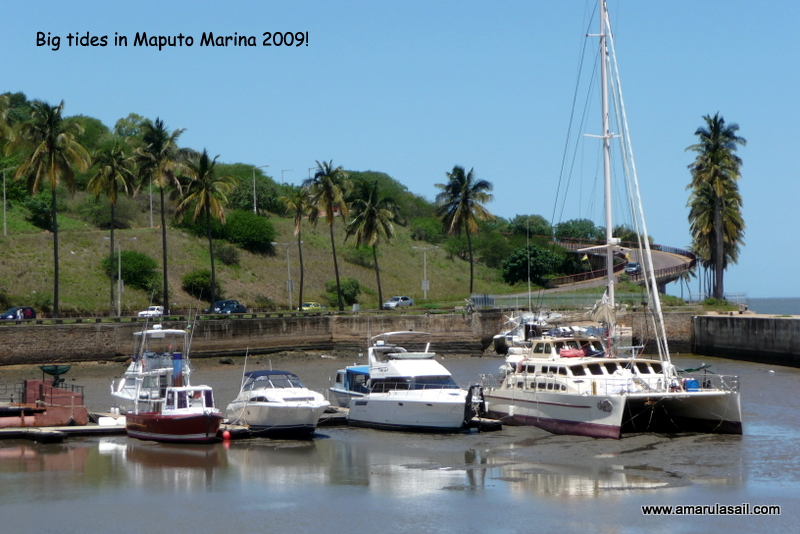
Eric (Captain - Australia) and Lynne (First Mate - England/Australia) began cruising in 2002 aboard Amarula, a 60' Crowther Catamaran hailing from Gibraltar that they build themselves.

They left Australia, cruising across the Indian Ocean to Tanzania. They stayed in Tanzania for 5 years doing charters and running a business. They visited countries along the African coast during that time. They left Tanzania for South Africa, eventually crossing the Atlantic to Brazil. They spent the next 4 years cruising up and down the Eastern Caribbean before sailing through Bonaire and Curacoa, and Columbia to Panama. After transiting the Panama Canal, they spent last season cruising across the Pacific to Fiji where they are currently.

They say: "We met in Dar es Salaam in 1993 where Eric was operating his prawn trawler (designed, built and owner operated) and Lynne went to teach at the International School of Tanganyika. Eric's dream had always been to build a yacht and sail around the world, to which Lynne responded "I'll be your crew!

We built our catamaran and launched her in July 2001 on the Clarence River, NSW, Australia. After a shake down cruise to Sydney for New Year & the fireworks, we set sail from Yamba, NSW in April 2002 around to Darwin, from where we began our circumnavigation in May 2002. We are still - very slowly - making our way around the world!"

You can learn more about their cruise on their website.

Having cruised both the Atlantic and the Pacific, how do they compare? 

We have cruised the Indian Ocean, the Atlantic and the Pacific. There is little comparison for me (Lynne), as the Indian Ocean was my first experience of an ocean crossing back in 2002. There were 5 of us onboard and we took 2 months from Darwin to Dar es Salaam, with a few short stops en route at Cocos Keeling, Chagos and Seychelles. We were on a mission to get back to Dar es Salaam, where we already had a few charter bookings lined up. But I LOVED being out on the open ocean, especially at night on my own in the wheelhouse or sitting out on deck enjoying the moon and the stars and complete serenity. We were fortunate with the weather! In fact, we motored miles north of our rhumbline looking for wind and at times just enjoyed floating at sea, swimming in the middle of the ocean thousands of miles away from anywhere.

We crossed the Atlantic from Walvis Bay, Namibia to Cabadelo, Brazil via a 6 day stopover in St. Helena in February/ March 2012. This time our only crew was our 2 Jack Russells, who did extremely well on their first ocean passage. We generally had reasonable winds and enjoyed a mostly downwind sail, thankfully avoiding the doldrums that a number of our fellow passage-makers 100 or so miles north of us lamented about daily on the morning radio net. We easily got into the groove of the passage and had no major dramas, but boy oh boy were the dogs happy when we finally made landfall in Brazil after 28 days at sea!

Meanwhile our Pacific crossing was easily the most challenging, perhaps because it is the most recent of our ocean crossings. We had an extra crew member, which especially helped with the night watches, but the first part of the sail towards the equator and the Galapagos was painfully slow. The grib files showed wind to the south of us and every time we started sailing towards it, it shifted further south. Remembering our Indian Ocean passage and the many hours of motoring, still failing to find the elusive wind, we spent some days just drifting and playing water frisbee with the dogs! As we struggled with either no wind or heavy squalls we were receiving emails from friends less than 100 miles south of us who were having a fantastic sail averaging 7 knots! Unfortunately, when we finally did get some wind the mainsheet block failed through crevice corrosion resulting in a ripped mainsail, then a few days later the block on our spinnaker snapped and our brand new spinnaker came tumbling down. This left us down to our 2 trusty headsails and we still had over 2000 miles to sail...... Add to this an almost complete lack of fish (4 in total in a 5 week passage!) and I can safely say we were all ready to set foot on land in the Marquesas!

Another thing we have noticed in the Pacific is that the weather forecasts have been invariably wrong and the winds have almost always been stronger than predicted, often from a completely different direction (see the answer below on danger)

Share a piece of cruising etiquette    

Maintain a good look out at all times and keep your radio on. Be ready to assist fellow cruisers and seafarers. We often came across fishermen as we cruised the Tanzania coastline who needed some kind of assistance, such as a tow due to broken outboard motors etc. On one occasion when we were heading to southern Tanzania for a bathymetric survey to study the reefs around Songo Songo island as part of the environmental impact study for the gas pipeline project, we stopped at Okuza island for a walk. We came across a huddled group of fishermen whose livelihood was catching and drying octopus. We soon discovered that they were stranded without water, as their supply boat hadn't shown up. As we had a watermaker onboard we offered to fill some jerry cans for them and immediately they came running over with at least 20x20 litre drums! We gave them over 200 litres of water and took one of them to the next island south where he was able to get further assistance. More recently, here in Fiji, a cruiser had run onto a reef and put out a Mayday call. We were about 5NM away at the time and changed course so we could assist.

What piece(s) of gear would you leave on the dock next time? Why? 

Because we built our catamaran for chartering we were talked into installing a dishwasher and a bar fridge, neither of which we ever used, so they became storage areas and we eventually gave them away in Africa and built in some large storage drawers instead. When we had a charter and wanted cold drinks we kept them in a cooler box on deck with ice blocks which we rotated from our freezer. As we had been based for a number of years in Tanzania prior to building the boat, we built Amarula as a stand-alone operation to operate as a charter vessel.

With the benefit of hindsight, what are the boat selection criteria you would use to purchase a boat for long term cruising?  

Eric: Max. 45'. Priority of importance: 2 oversize anchors with minimum 100 metres chain and good anchor winch plus extra rode, robust auto helm, fish finder with portable hand-held depth sounder (Hondex PS-7), plenty of solar and wind to run large fridge/ freezer, good sail wardrobe (including headsail, staysail, mainsail, code zero/ spinnaker), enclosed cockpit/ wheelhouse for comfortable cruising in all weather, good stowage, Hard bottom dinghy with mimimum 9.8HP for river and reef exploration trips.

What type of watch schedule do you normally use while offshore? 

With just 2 of us we tend to do 3 - 4 hour watches usually starting around 1900 - 2300 (Lynne), 2300 - 0300 (Eric), 0300 - 0600 (Lynne), 0600 ~ (Eric). On the few occasions where we have had extra crew on long passages we do 3 hour watches.

Have you ever felt in danger and if so, what was the source?  

On passage we have generally picked our weather windows well and been fortunate to have some excellent downwind runs. On a couple of occasions we have run into unpleasant squalls of 40+ knots or so. For example, despite all the forecasts showing light winds from the NW we hit 40 knot squalls from the SE when we were heading from the Marquesas to the Tuamotus in French Polynesia and had to heave to for a few hours - our first time ever. Back in 2002 we did a marine research charter to Aldabra and Cosmoledo islands in the Seychelles and we found ourselves sailing/ motoring head on into the first named cyclone to form above 10 degrees south and we took a battering. Unfortunately, we didn't have the luxury of being in a position to plan this passage, as this was a commercial charter that we had committed to. It also demonstrates the importance of timing your passages.

As for other kinds of dangers, when we were at anchor in Taganga Bay, Colombia, in November 2015, we were unfortunately boarded by armed pirates and robbed at gun & knife point. Meanwhile, we spent many years cruising up and down the coast of East Africa without any unpleasant incidents and in fact we had some of our most memorable experiences in that region.

How much does cruising cost?    

Again, this is a question that every cruiser would have a different answer for. Some people do it on an absolute shoe string budget never eating or drinking ashore at bars and restaurants, never taking tours or hiring cars or staying in marinas, others go all out and use cruising as a way to travel from country to country and base there, then experience just about everything that country has to offer including staying in marinas, going on shore based excursions etc. When we closed off our business in Tanzania and set off cruising we had a very healthy stock market portfolio and felt ready to take on the world and see and experience each new country to the max. In our first couple of years cruising during the GFC, we lost a huge portion of our portfolio and have been shoestring cruisers ever since! However we have had many incredible experiences and have met some fantastic people.

What is a cruising tip or a trick you learned along the way?    

Go with the wind. Relax and enjoy, rather than try to rush to meet schedules and be prepared to change your plans. We also really enjoy exploring anchorages off the beaten track and especially meeting and getting to know local people.

In your own experience and your experience meeting other cruisers, what are the common reasons people stop cruising?    

There are so many reasons. Probably the most common being age/ health/ mobility issues, finances, time for a new challenge, end of a circumnavigation and grandchildren coming along! One thing we have noticed is that many cruisers go on to become land cruisers. Perhaps we will in the not too distant future...... But one idea that we are tossing around, now that we're almost done with cruising and much closer to home is to offer 'educational retreats' onboard for wannabe/ soon to be offshore cruisers - a kind of 'try before you buy' situation where people can come and test out the lifestyle, ask questions, learn the ropes so to speak - we'd love to hear from anyone who may be keen to try something like this and we can be contacted via our website.

What question do you wish I would have asked you besides the ones I've asked you and how would you answer it?

Eric: Would you circumnavigate again? Yes!

Lynne: Would you like to continue living this lifestyle? Absolutely! 

21 August 2017

10 Questions for Tranquility Bay

Scott, Kimberly and their ship cat Allie have been cruising since 2005 aboard SV Tranquility Bay, a 38' aluminum Groupe Finot Reve d'Antilles hailing out of Detroit, MI, USA. They have spent the last twelve years sailing up and down the east coast of America and throughout the Caribbean.

They say: "From the glass towers of NYC to the steamy jungles of the Banana Republics, we've been pondering escapism and searching for a more connected and meaningful way of life.

You can learn more about their cruise at their website and their YouTube channel.

Tell me your favorite thing and your least favorite thing about your boat

We take it for granted that our boat is incredibly strong. It always brings us feelings of security when the going gets rough. Something that appeals to us more regularly, however, is it's uniqueness. A lot of people – especially in the States – don't know what to make of it. It may as well be a spaceship with its unpainted aluminum topsides and bubble. People are usually very surprised when they come inside and settle into its cozy wood interior.

Our least favorite thing about our boat is that it is often difficult to go unnoticed. Its rugged fishing boat-like appearance has always appealed to us because in our minds it has a simple look, and not a yachty one. When we arrived in Panama, however, where most of the indigenous population paddles dugout canoes, it was hard to ignore the frequent amazement of many of the locals. They pound on the side grinning and say, “Aluminio!” Then they chuckle about scrap prices and the equivalent amount of recycled cans that they'd have to collect to make as much money as they could get by cutting off a chunk of our hull. Sometimes they make us nervous.

What is the next piece of gear you would add to your boat if it were free?

We'd love to have a set of lithium batteries. They're so light weight and put out so much juice. It would be a huge boon to our cruising comfort and if we ever ended up shipwrecked, we'd be carrying our own extensive prescription for depression. However, considering that lithium is a limited resource and witnessing the roadblocks faced by the electric car industry, we don't have fuzzy feelings about any big changes coming soon. But we'd sell our soul for a set of those babies! (hello sponsors?)

In your experience, how often do you think cruisers spend sailing vs. motoring, coastally vs. on passage?

The percentage of motoring vs. actual sailing is hard to know, but what we certainly can say from our own experience is that there is a lot of impatience in the world. If you've just abandoned a thirty-year mortgage or walked away from an unfulfilling career and hopped aboard a sailboat, it can be hard to restrain your excitement. The wind isn't blowing, but you're anxious for the 'real' adventure to begin so you crank up the iron genny and head off, despite a forecast of glassy calm. Or in our own case, you start out making the mistake of jumping at the first stormy opportunity, puff out your chest and call yourselves 'real' sailors. Then you take a severe beating, and spend the next week shore-side looking for parts to replace everything you broke.

We see a lot of people out here trying to girdle the globe during one year sabbaticals. We also see lots of retirees deep into the final chapter of their lives – frequently complaining about there being “too much wind this year.” Of course people that have been out traveling longer tend to be tuned in closer to Mother Nature's frequencies, but really, the true percentages of sailing/motoring are all over the map. I don't think there is a science or study to accurately describe what percentage at any given time choose to motor or sail. Maybe chaos theory?

Spending days on end deafened by a throbbing engine, and enveloped in a cloud of soot isn't so magical. On the other hand, beating your brains back and forth and not making it into an anchorage before dark just to lay claim to some kind of sailing prowess certainly isn't smart either. Everybody wants to paint the perfect picture of their sail through paradise, but sometimes, you just have to eat it – with torn sails or a bruised ego. So … .. . 50/50???

What do you dislike about cruising that surprised you?

There is always a lot of talk about the cruising community. The number of people actually going someplace in their boats is probably equivalent to the population of a small town, so it seems like a fitting analogy. It's remarkable how often we cross paths with the same people flitting about on sailboats.

We've had friends on boats deliver generous loads of medical and school supplies to third world villages. We've met crazy wandering gypsies that have told us stories about parts of the globe that we've never heard of. We've also met folks on shore that have welcomed us with open arms thanks to the many ambassadors of good will that have traveled before us. And then, there are the Hamburger Cruisers.

There are a lot of Hamburger Cruisers out here. Most of them are pretty friendly. Don't get us wrong, many of them have been wonderful to us, but it often seems that their main priority is to eat hamburgers in every country they visit. On an extended progressive dinner party, Hamburger Cruisers travel great lengths, at great expense and discomfort, seemingly, only to find their next patty. Sometimes, however, when there are no burgers to be found – things can get ugly.

What is a cruising tip or a trick you learned along the way?

Slow down and open yourself up to new experiences beyond sampling some local food and taking a tour. Ask yourself why you've signed up for this adventure. We often meet new people trying out life on a sailboat that think they're subscribing to some kind of special 'lifestyle' that they've caught a glimpse of on YouTube, but living and traveling on a boat isn't easy. It takes awhile just to get comfortable with your floating home and develop an understanding for how things work.

We've lost count of the number of times we've met cruisers committed to crazy accelerated plans – things like two year circumnavigations. They often have scarcely enough time to even say hello, much less keep their boat together before rushing off to the next spot. From what we've seen, it's a horrible way to see the world. What is the sense of traveling thousands of miles at great expense and a snails pace, only to do a waterfall tour and head off to the next place?

In your own experience and your experience meeting other cruisers, what are the common reasons people stop cruising?

Probably the most common reason we find people bailing out early is that they've discovered traveling by sailboat was much more difficult and uncomfortable than they had imagined. It never occurred to them what it might feel like to get beat up for days on end. It continuously amazes us how many people – young and old – we watch head out for the first time after lengthy preparation, only to call it quits after they've had their first rough experience. Old age, and difficulties coping with the simple drudgery of operating a boat and living on it is another reason. Sometimes, the missus just wants to be with her grandchildren.

Where was your favorite place to visit and why?

It's hard to pin down one place, but we do have fond memories of our time in Venezuela. We entered the country shortly after their president called ours the devil. Despite some positive reports we heard before departing Grenada, we had reservations. More than one couple tried to convince us that “Hugo Chaves will confiscate your boat.” While we thought this was foolish, we did debate flying a Canadian flag to save face. Later, we thought that was foolish as well.

The Venezuelans were some of the friendliest people we've met in our travels, and the diverse scenery there was otherworldly. There was a serious crime problem everywhere we went, but thanks to a howling black market currency exchange, we remained somewhat blind to the dangers. Trading a personal check for a backpack full of money was unbelievably exciting. It was like living in the old Wild West.

Over the coarse of a year, we rode a towering wave of economic collapse. Fuel was thirty cents a gallon – delivered. To our surprise, in addition to discovering that Venezuela was indeed a democracy, we learned that the island of Margarita was full of top notch shopping centers where we loaded up with goods at pennies on the black market dollar. We filled shopping cart after shopping cart full of quality liquors, exotic brands of chocolate and giant wheels of cheese. Lomito, Spanish for tenderloin, cost less than ground chuck, so we ate it like hamburger.

We had a great time in Venezuela, and we've never regretted taking advantage of the economic situation there. We were even given free health care as visitors. What's most interesting, however, are people's reactions to our stories about this amazing place. We tell stories of many of our friends that still live there, and of all of the starving Venezuelans – still being crushed by the world oil economy. But the most striking response we ever get back at home is, “gas only cost thirty cents a gallon?!?!”

Over the time that you have been cruising has the world of cruising changed?

Venezuela seems to no longer be an option for cruisers. It is now the world's largest remaining oil reserve – and an economic war zone.

Cruiser rant: What is something that drives you crazy?

People that tell us, “it must be nice to live like you do.” They say it as if they themselves have somehow been cursed. It drives us crazy how people complain about their hectic lives in America. They often hear only what they want to from our stories. We fish. We swim in paradise. We drink cocktails at every sunset.

After meeting so many happy families that live in palm thatched huts with dirt floors – people that swim in the oceans, eat fresh food out of the jungle, and breathe the fresh air – it's really hard to listen attentively to some our friends or relatives complaining incessantly about the horrible complications of their material worlds.

What question do you wish I would have asked you besides the ones I've asked you and how would you answer it?

So I hear you guys have started a YouTube channel, what do you hope to achieve?

We'd like to share what we've learned in the last twelve years of our sailing experience and inspire others to follow their dreams. Currently we are completely overhauling/reconstructing our boat to outfit it for travel to colder climates. It has always been our ambition to travel to the edge of the icepack to see with our own eyes how the world is being changed. We'd like to take anyone else interested in the conversation about the future along for the ride in hopes of increasing awareness of the current situation. Come along for the ride at Sailing Tranquility Bay

07 August 2017

10 Questions for Journey

Wayne Seitz & Dana Greyson cruised from 2012 until 2017 aboard SV Journey, a 1977 Pearson 365 ketch, hailing from Portland, OR, USA (though Journey's never been there).

They bought Journey in St. Lucia and sailed up the Caribbean chain, back to Florida. From there they spent time in the Bahamas before returning to Florida, before continuing on through to the Panama Canal. They crossed the Pacific to New Zealand, then spent another season in the islands before finishing their cruise in Australia where they sold their boat.

They say: "We do see ourselves returning to cruising down the road, though not likely making a trans-Pacific crossing. Wayne, a savvy mechanic, is still a frequent contributor to the Pearson owners forum.  We're incredibly humbled by and grateful to the many Pearson owners generosity to us.  I've published a number of Cruising World shorts, the most recent in June/July '17, a heartwarming story about an island dog in New Caledonia supported by cruisers via Cat Impi's GoFundMe campaign."

You can learn more about their cruise on their blog.

With the benefit of hindsight, what are the boat selection criteria you would use to purchase a boat for long term cruising?

For the money, we still felt we did well with our Pearson 365; safety -- a solid blue water boat on a budget was our driving criteria.  Journey definitely delivered.  With a bigger budget, a boat with a "man cave" and a better alternative to our v-berth for sleeping would've been excellent.  We were very tempted partway into our cruising to switch to a Manta 37 catamaran for its more comfortable layout, but decided it was outside our budget and felt more confident we would recoup our buying price more easily with a lower cost boat, like our Pearson.  We'd still have preferred a cutter rig over a ketch.

Bottom line:  better speed and more comfort would've made long passages less stressful.

What (if anything) do you wish someone had told you before you started cruising?

Get new sails -- at least a new mainsail -- before you go if you plan to do substantial cruising, even if what you have is in okay condition.  We figure we spent more money fixing what what we had than we would have for new sails, and we would've sailed much more efficiently, too.

While SSBs are slowly being replaced by satellite technology, we wish we had a working SSB setup not only for safety, but also to be more connected with cruiser nets, especially for the Pacific Puddle Jump (PPJ)

Buying your boat outside the US offers greater than expected challenges when it comes to getting your boat cruise-ready (especially when it comes to getting the parts you need affordably - or at all). After we sailed to the US, we left with a LOT of spares for the rest of our journey and they served us well.

We actually did this - worked at West Marine part time to enjoy the awesome employee discount on our boat gear.  We thanked West Marine every day for the gear we'd never have had the budget to buy full retail.  We also got fabulous advice from Milltown Sailing club (in Everett WA), Wendy Hinman ("Tightwads on the Loose" and "Sea Trials" author) and Seattle Women in Boating.  Connecting with the sailing/boating community (experienced folks who are not connected with selling you stuff) and the Pearson forum was invaluable.  We also crewed on three boats before we left, which taught us some good lessons.  Wayne read just about everything he could get his hands on online about cruising (including Interview with a Cruiser).

What are some of your favorite pieces of gear on your boat and why?

Our oversized Rocna anchor.  We got it after our first season and slept much better after that.  The only time we dragged once we got the 42lb  Rocna anchor was because our windlass broke so we scarcely put down any chain.

CPT autopilot.  Not fancy or integrated but incredibly more robust than other more popular wheel pilots.  Incredible customer service, too.

An illegal propane instant-on hot water heater for a darned nice shower for a boat as relatively small as ours.  Even in the tropics a hot shower just makes you feel more human afterward.

Iridium Go! wifi hotspot with Predict Wind. Getting accurate relatively forecasts in middle of the ocean was pretty awesome, as was keeping in touch via texting from it (the latter really helped me feel less isolated on long passages like the 32 days it took us to go from Galapagos to the French Marquesas).

Soda Stream soda machine- great way to keep drinking water interesting without having all the extra soda bottles or lugging them shore-to-ship.

How much does cruising cost?

We paid $30,000 cash for our sturdy 1977 Pearson 365 sailboat.  We chose to aim for a fairly lean cruising budget of $1500 month for everything - from boat repair, to food, customs and immigration, entertainment  -- everything.  In places like Fiji we had no problem coming in under budget. However extensive boat maintenance and repairs in New Zealand and overall cost of living in Australia put us over budget in those areas.  We also chose to not insure our boat or carry health insurance, which we knew was risky but also prompted us to take less risks.  We also trusted fate and were willing to pay out of pocket for any medical needs.  We rarely stayed in marinas.  On the backside, after all our import and pre-sale and commission costs (~$10K USD), we sold our boat for a net of ~$46K USD. That net included putting in some extra work to save 5% duty on the valuation price (for a US-built boat under the thanks to the US Trade Act Agreement) and selling off boat accessories (ex. Iridium Go!, life raft, backup autopilot, etc. for $3.5K) not required by Journey's new owner.  Our boat sale was not really a $16K profit!  We spent a significant amount of money on maintenance, repairs (like this one) and gear well beyond $16K, and we were pretty frugal.

What do you dislike about cruising that surprised you? 

Too many long, uncomfortable passages -- and relatively speaking ours were fairly benign.  Thanks to doldrums, contrary winds (often despite what was forecast), currents that behaved differently than anticipated, torn sails, etc. most passages took us longer than expected.  Having a genuinely pleasant sail, however, was exceptionally rare for us.  Also, with the two of us as sole crew, we missed quality time together while on long passages.  There's no sleeping together when one of you always has to be on watch.

What is your most common sail combination on passage? 

Jib only, followed by main and jib.  We had a mizzen which we rarely used.  Our autopilot was very prone to weather helm, which led us to a very cautious approach on how much sail we put up.

Was there anywhere you visited that you thought was overrated (not as good as you had heard)? 

Panama's official check-in rudeness and cost soured us when we first came to the country to a point it was difficult to overcome (though Isla Contadora, our last Panama stop was a great place to relax).

Bora Bora's over-commercialization turned us off

Vanuatu's cruise-shippy Efate was also an area where it seemed little could be enjoyed for free.

Was there anywhere you visited that you thought was underrated (better than you had heard)?  

New Caledonia was a pleasant surprise, refreshing us after we'd felt somewhat burned out.  The sailing was easy, anchorages plentiful and varied, with lots of well-maintained hiking trails and islands with great snorkeling.  We appreciate the ease of checking in and out of most French territories and New Caledonia was no exception.

Spanish Virgins were charming, far more interesting and less commercial ashore than BVIs or USVIs

Maupiti was a sweet place, unplanned to end our stay in French Polynesia with our favorite lookout point view.  We were fortunate to catch a good weather window in; we saw how nasty its narrow reef entrance can get the day after we arrived.

Share a piece of cruising etiquette  

When you socialize with other cruisers in an anchorage, consider casting your net wider to invite the whole anchorage.  Make a point of at least saying "hello" and introducing yourself to other cruisers in the anchorage, even if your default is to just stick with the folks you're buddy-boating with.  You never know just how much being inclusive is appreciated, or how much being left out can sting.

In your own experience and your experience meeting other cruisers, what are the common reasons people stop cruising?

In our case, we stuck to our plan, a budget enough to cover 5 years of cruising, and we were reticent to tackle the sailing challenges between Australia and the US to finish a circumnavigation.  We completed our goal; even if ours was halfway around the world (others stop when they circle the whole blue marble).  Missing our friends, but especially parents, especially those who don't travel and are in their late 80s and 90s, also prompted our return home -- all the more so as our budget didn't include trips home to visit friends and family. We've observed cruising parents needing to usher their children into college are one call to end cruising.  Health issues, among cruisers themselves, or with other family members are prime reasons to stop cruising.  An empty cruising kitty is often easier to replenish with a long break from cruising, and a return to more traditional work for a while.

Particularly for frugal cruisers like us, at some point the clarion call of a queen-sized bed you don't whack your head on when you sit up and endless hot showers is darned compelling.

What question do you wish I would have asked you besides the ones I've asked you and how would you answer it?  

What scared you?  (specifically, we were often asked about "pirates" and "storms" as well as other "I wouldn't go because" questions....)

We never encountered pirates, because they're not that common and Noonsite offers excellent information on areas to avoid.  The only time we ever got "boarded" was by a confused homeless fellow in Jacksonville FL; he left without incident.

We never encountered sustained winds of over 30 knots or sustained waves over 4 meters (and >1-2 meters were most common) - boring but true

What scared us the most was our last long passage - two seriously nasty lightening storms coming into Bundaberg Australia. The first lasted about 2 hours, followed later by a shorter lightening storm in our last few miles in.  Both times, we dropped our sails, turned off our electronics and put all we could in our "Faraday cage" (oven) in anti-stat bags.  We didn't get hit, but sure thought we would.
Overall, we were incredibly lucky as well as well prepared.  We also can't help but wonder how many other boats cruise relatively unscathed... it just doesn't make as interesting "press" but all those scary stories sure do discourage a lot of folks from ever considering even getting into a boat, much less distance cruising.

31 July 2017

10 Questions for Tainui

John Vallentine cruised from 2005 until 2016 aboard SY Tainui, a Formosa 46 hailing from Mooloolaba, Australia. He had various crew, especially Maxine Maters, Ian Allan, & David Lucas.

You can read more about his cruise on his website.

Over the time that you have been cruising, has the world of cruising changed?   

Yes. The remote world is shrinking. We have always pursued remote cruising grounds, preferably in high latitudes where they can still be found.

Follow-up question: Any examples of the remote world shrinking?

The Galapagos, Lord Howe Island, Trinidad, Tahiti, Marquesas and Cuba all come to mind.

In the Caribbean, I wish I'd been to the Windward Islands 50 years ago.

I don't want to give you the wrong impression though. We cruised many places in solitude - Patagonia, Haiti, Newfoundland, Labrador, Iceland, Faroe, Arctic Norway and Svalbard, virtually all of Russia, Venezuela, Colombia and Ecuador. The list is still long enough for a lifetime's sailing.

Having cruised both the Atlantic and the Pacific, how do they compare?

The Atlantic is excellent for high latitude cruising – Labrador, Iceland, Svalbard, Patagonia etc. But the equatorial milk runs are boring.

The Pacific islands are becoming quite crowded but even as late as 2015 we found empty places – Tuamotus, Niue, Beveridge etc. The sailing is grand if you are going downwind.

What is a cruising tip or a trick you learned along the way?

My favourite trick is to break my travels with trips home.  It is great to leave the boat and great to return. And you can stash the boat in cyclone holes or snow-bound ports.

In your own experience and your experience meeting other cruisers, what are the common reasons people stop cruising?

There are many reasons why people stop cruising. Boredom, aimlessness, financial distress and partnership  breakups are all common.

Cruiser rant: What is something that drives you crazy?

More than anything else, I am driven crazy by fleets of Bavaria and Beneteau charter boats – what Ian calls “Eurovision Song Contest” boats. These are worse in the Med, of course.

I am also very irritated by boats which run generators at night, boats which anchor stupidly  too close ahead of me, and those wind generators which whistle noisily.

Have you ever felt in danger and if so, what was the source?  

Not really. Perhaps in a southern Ocean gale when we were surfing under bare poles at 18 knots I felt we were on a bit of a knife edge but our Aries coped effortlessly.

What is your most common sail combination on passage?

I like having the boat pulled along by the nose. Obviates the danger of broaches and gybes.

In the high latitudes, poled out storm staysail with/without poled out yankee.

In tropical grounds, poled out #1 and genniker. Sometimes with the main as well

What piece of gear seems to break the most often?  

Our 40 year old Ford Lehman engine needed regular coddling. Sheet chafe is a constant danger which can be avoided. Sail wear and tear is inevitable.

With the benefit of hindsight, what are the boat selection criteria you would use to purchase a boat for long term cruising?

Solid, simple, seaworthy and with good sailing ability. There is no better boat than the Peterson/Formosa 46 for this.

What question do you wish I would have asked you besides the ones I've asked you and how would you answer it?

What next?

I don't have a specific answer to this, but my future will always include the sea and boats.


01 May 2017

10 Questions for Domino

JP and Marie have been cruising since 2010 aboard MV DOMINO, a 65' Malcolm Tennant Power Catamaran flagged in Pago Pago, American Samoa.

Since 2010, they have cruised from Paraguay to Argentina, Uruguay, the entire East coast of South America, Caribbean Islands, Cuba, Yucatán, the entire East coast of the US and the Chesapeake Bay, Central America (Caribbean side), Panama, Galapagos, Marquesas, Tuamotus, Tahiti and its Islands, Samoa, Fiji, New Zealand, and now New Caledonia.

JP and Marie built DOMINO themselves and they left behind 6 children and 13 grandchildren when they headed out cruising. DOMINO is currently for sale

Read more about their journey on their blog.

Finish this sentence. "Generally when I am provisioning...". 

I look for the freshest produce and canned goods with the least additives, enjoying the opportunity to discover local flavors.  At the town market, I often ask the ladies how to prepare the produce they sell.

What do you enjoy about cruising that you didn't expect to enjoy?  

Doing nothing.  I never thought I would enjoy just sitting, meditating, looking at nature, doing nothing at all.

How did you (or did you) gain offshore experience prior to leaving?   

Uh... we didn't.  Just hopped on the boat and left.  1 day passage, followed by a 2-day passage, and so on.

Share a piece of cruising etiquette

To guests who come and cruise for a while: don't bring roll-away suitcases.  Backpacks and soft bags do not scratch the decks and are easier to stow away.  To dinner/happy hour guests who kindly bring drinks on board: please, take your rubbish with you as you leave.

In your own experience and your experience meeting other cruisers, what are the common reasons people stop cruising? 
  • They get on each other's nerves
  • They have gone as far west as they dared
  • They miss family and land possessions
Tell me your favorite thing and your least favorite thing about your boat  

Favorite: Parties 60, dines 8, sleeps 2.

My least favorite thing?   Umm.. no washing machine!  Of course, we have the room for it, all the electrical and plumbing, easy ventilation for the washer/dryer combo, but no machine!  I think JP uses this as leverage... after 10 years of doing my laundry in an oversized sink, spinning it in a high speed spinner and drying it in the sun, I still hope that some day I won't have to depend on the weather to do my laundry!

What are some of your favorite pieces of gear on your boat and why?  
  • Refrigerator- I can't imagine cruising without one, and mine is quite large, enough for 6 weeks of fresh produce.
  • Bread machine - We're French, therefore eat a lot of bread!
  • Our big 6' radar array antenna.  We see targets clearly and early... peace of mind.
Where was your favorite place to visit and why?  

The Galapagos.  There is nothing like it, above or below water.  Unique!

What mistakes did you make in your first year of cruising?  

Plenty! Racing the Brazilian Coast Guards entering Rio de Janeiro while ignoring the proper entrance channel, as the coast guards had fun pinning us on the rocks is my favorite!

What question do you wish I would have asked you besides the ones I've asked you and how would you answer it?  

How do you not get on each other's nerve when you live in confined quarters 24/7?   

Headphones, private space, yoga, and a sense of humor!

23 January 2012

10 Questions for DreamKeeper

dreamkeeper1 Gar Duke and Nicole Friend circumnavigated from the winter of 2006 until the summer of 2011 aboard SV DreamKeeper, a Pacific Seacraft 40 hailing from Sausalito, CA, USA. You can learn more about their journey on their website.

They say:  We started in our home port of Sausalito in the San Francisco Bay, CA, and went south in winter to Mexico then across the South Pacific to New Zealand.  Year 2 took us thru Melanesia to Palau, Micronesia, with a 4 month layover in Palau.  Year 3 we dropped south into West Papua/Raja Ampat around PNG into east Indonesia and all the way to Bali, then up to Singapore, Malaysia and Thailand.  Year 4 was a big mile year, first crossing the Indian Ocean and up the Red Sea, thru the Med, across the Atlantic and to the Caribbean to end the year.  Year 5 started heading west to Bonaire, the Kuna Yala of Panama, then thru the Panama Canal, up the central American coast and Mexican coast, and finally Baja-bashed it back to San Diego with the last leg up the California coast to San Francisco.  4 ½ years total San Francisco to San Francisco.

What mistakes did you make in your first year of cruising?

Gar:  there were a lot, but here’s a few:

First mistake we made was day 1 out the gate of San Fran, where we turned left and proceeded to do an overnight passage to Monterey Bay.  We were so fast we had to heave-to in the bay all night in sloppy seas, super cold temps, and pitch black conditions leaving me seasick all night long in sensory deprivation and Nicole needing to deal.  I was a total mess.  In hindsight, we should have planned better and just done a day hop down to Half Moon Bay to finally GO and commit to the journey, but in a much easier way for where we were at then.  Thankfully we had leftover Thanksgiving dinner for brunch the next day in Monterey as I was famished!

Leaving the US without a few spares that we wanted for the South Pacific and thinking they’d be easy to get in Mexico.  Not easy and definitely not easy to ship to Mexico either.  Nicole had to fly back to the US and load up a couple bags full of gear so we had what we wanted for the South Pacific and then still brave the dreaded “green light/red light” at the Mexican aeropuerto customs.  Unlucky you if you get the red light!

FYI, It’s much easier and way cheaper to get everything you think you might need in the US on your boat if you can, but at that time we were still very much “green” on our boat and figuring everything out.  All this being said only because we come from a place of liking to be very self-sufficient and prepared for as much as possible and also our intention to head west quickly across the South Pacific the first season out.  If you stay in Mexico long enough, like most cruisers, you will probably be high-tailing back to good ‘ole USA anyways at some point.

Worrying about and spending time and energy getting a HAM radio license.  So many people told me I should DEFINITELY get this license in Mexico before the SoPac, but, for me, not being a big radio talker, I never really used this with the exception of the services of winlink in the beginning of our journey.  Later, after seeing the advantages and convenience of using the services of UUPLUS email thru our satphone, winlink became only a back-up for us.  

And not to say we never chatted on the SSB with friends or on radio nets, but none of them were ever “Ham only” nets, so my whole ordeal of getting a HAM license was, for me, a waste of time.  If you LOVE to talk on the radio, then by all means, get a HAM, but if not, forget about it and go surfing or do something fun instead.

Nicole: Telling my mom I would call her by a certain date.   My parents bought us a sat phone for emergencies and perhaps more specifically so we could talk while on passage and they wouldn’t worry about us.  I made a bad call and told my mom I would call her by a certain date.  Somehow, we didn’t quite figure the sat phone out while travelling south along the Mexican coast and my phone date was passing.  I knew my mom would be worried sick and start calling anyone she could think of so we had to detour to Abreojos, a tiny fishing village along the Baja Pacific coast, in deteriorating conditions to make that call. We found a phone card and then found the phone. I called to let her know we were fine and then we headed back out through bigger surf and out to our bucking boat.  Note to self, never give anyone a time line you can’t keep.

Describe the compromises (if any) you have made in your cruising to stay on a budget?

Gar/Nicole:  For us, our budget living on the sailboat was a lot cheaper then our budget living on land.  We had just sold our home, cars, and most everything else we owned that wouldn’t come with us and so we axed everything like property expenses, utility expenses, auto expenses, and all the other pieces that add up so quickly living in the US.  In cruising, boat expenses are hands down the most expensive reality.  But…most of the boat expenses can be coined “luxury” expenses like good electronics, a water-maker, a new sail, etc., and you can get by with very little if your boat itself is solid and safe.  

In our opinion you can cruise on almost ANY budget once you own a boat.  It’s all choices and how you tailor your lifestyle and choices around your “wants” in life.   It’s no different then how you choose to live your life on land.  If money is tighter for you cruising, then don’t eat out much or use the engine as much or buy lots of fancy boating gear you don’t really need.  And, lastly, learn how to fix and work on your own boat; that, in itself, will save you lots of money in the long run.

What is something you think potential cruisers are afraid of that they shouldn’t fear?

Gar/Nicole:  Passage-making. It’s scary at first if you have never been offshore on your own boat with a small number of people and we get that.  But, in reality, this is a great time to actually just “be” with the ocean at all times of the day and night that you will most likely never experience any other way. 

For us the first few days are the most difficult of a passage as we are adapting to a new schedule.  But, if you plan well with the weather, make some pre-prepared meals, have a good book (or 2 or 3) put aside, maybe some podcasts or audiobooks for rougher weather, and have a good watch schedule so you get some rest when you need it, you will most likely really enjoy the experience.   Keep a journal or write a daily blog just to keep notes on the little things you see and feel and hear.  It’s a unique experience, embrace it and don’t fear it.

What is something potential cruisers don’t worry about that perhaps they should?

Gar/Nicole: Being thoughtful about locking your gear and boat up.  Cruisers have a tendency to be very lazy sometimes.  Lock up your dinghy and outboard, put away or lock up any gear on deck that is worth anything to you, and lock up your cabin when you are away from your boat.  It seems so simple, but we have seen boats all over the world complaining in hysterics about how someone stole their laptop from their un-locked cabin or stole their unlocked outboard or dinghy in the middle of the night.  Well, did you lock your cabin? “uhhhh…no, I never do…it’s just so hot.”  Did you lock up or raise your dinghy at night?  “Uhhhh….no, it was windy and rough and rainy out and I thought no one would come out on a night like that” (but that’s when they always do).

Cruisers need to realize that no matter what their budget is or how non-fancy their boat is, they are still looked upon as “rich” in almost any country around the world they travel to.  So many of the cultures you will connect to will be living with almost nothing and there are always people on the look out to make a quick buck the easy way.  Also, it felt important for us to acknowledge some communities don’t have things like private property so ours was even more interesting.  You will still stand out even if you are dirt-bagging it with a half sunk boat and not a penny to your name.  Ask any long-term backpacker traveller you meet, it’s not about being paranoid, it’s just being extra-aware of where you are.

What are some of your favorite pieces of gear on your boat and why?

Gar:  Electric anchor windlass and oversized anchor, wind generator, and AIS system.

A good solid and reliable electric anchor windlass with an oversized anchor makes a huge difference when you are cruising.  Of course, these are still luxury items, but they do make life much easier and safer when you drop your hook and don’t worry about it dragging and also know you can always get it back up without a hurting your back in any conditions.  I can’t count the times we have needed to move anchorages in inclement weather in the middle of the night because of bad weather or change of wind or swell direction and how thankful we have been that our electric windlass was working well.

We have a KISS and wouldn’t think of having another type of wind generator unless it had the same specs.  It is quiet, simple, and puts out lots of juice.  If you have a noisy wind gen you will absolutely hate it and so will your neighbors, plus they usually don’t make much energy anway.  We try to anchor in places with some wind in the tropics as it cools down the boat and usually keeps us pointing into the prevailing swell so you don’t roll as much.  We cruised without a generator onboard, so a good wind generator makes a huge difference in keeping your batteries up regardless if you have solar or not.

We added an AIS system halfway around on our circumnavigation when we were in Thailand.  It made a huge difference with piece of mind and safety when it came to passages through busy shipping areas and especially at night with just 2 of us onboard.  Radar was still a great tool for us to use, especially for fishing vessels not usually on AIS, but the reality of today is that AIS is used now on ALL big ships and you will wonder how you got by without it once you start using it.  A simple AIS receive unit is not very expensive and will be invaluable if you are choosing a route where you will be in shipping lanes and around shipping traffic often.  Of course, if you are only a coastal cruiser and are one not to be crossing oceans much or ever, then an AIS will be just another ‘not needed much’ luxury piece of gear.

Nicole:  OK I love all three pieces of gear Gar mentioned and would prefer not to go without them.  All three in my mind are fabulous luxury items we were grateful for every day.  The AIS completely changed my stress level on night watch. I, for some reason have always had a hard time with depth perception even with using radar and tracking and all of the tools I could use.  The AIS system changed all of that.  I still kept a thorough watch but I could tell where ships were going and coming and if I needed to make a course change without any guess work.

And another piece of boat gear, our Monitor windvane.  I can’t imagine having left without him.  He has served us well as third crew on all of our passages that had wind.

Also, with regards to food and fishing gear, I loved our fishing hand-lines and squid lures, my “yo-gourmet” yogurt maker (bought in New Zealand), along with our jar sprouter, and Braun hand blender.  Sometimes it’s the little things that mattered like being able to eat fresh things on day 20 of a passage.

In your own experience and your experience meeting other cruisers, what are the common reasons people stop cruising?

Gar/Nicole:  If you are a younger cruiser, then most folks are only out for a short time and need to either stop to work or could just make a season or perhaps 2 work. Retired-from-work aged cruisers usually stop because of health issues or because they are over the novelty of cruising and want to be home again closer to kids and grandkids. 

But there are still many people of all ages that go out for a bit and just realize that it’s not for them for one reason or another.  The reality of the cruising lifestyle is very different from where most people are coming from before jumping on their boat.  I would say that most people have no idea how much work both physically and mentally it is if you are a full-time cruiser and actually moving your boat around.  The romance of margaritas in your cockpit while the sun is setting can definitely ring true sometimes, but the other pieces of constant wear/tear on your boat and body and the need to be constantly ‘on it’ in regards to planning, maintenance, traveling, and safety takes a lot more energy then most non-cruisers or wanna-be cruisers realize until they do it for a while.

The people we met who were out there for a while moved their boat less, and stayed places longer, they over-wintered and spent two summers in the Med, they spent two winters or more in Mexico or the Caribbean, they stayed in Fiji for hurricane season.  Or they tied up their boats and went home or somewhere for a 4-6 month break or to go back to work and then returned to their boats again.

What is something that you read or heard about cruising, that you didn’t find to be true?

Gar:  I read quite a bit about cruising before we left on this journey and so feel like I had a pretty realistic picture of what it all entailed.  However, that being said, I think I still had an unrealistic perception that the cruising “community” was a pretty adventurous, and mostly open-minded, and just plain open to everything and everyone, group of people.   What we experienced quite a bit, unfortunately, was a lot of people traveling on boats that were more interested in their easy “nationality clicks” and “sundowner” lifestyles then really putting themselves out there to embrace local people, local cultures, and other cruisers from other countries.   We always pictured all these different folks from random countries hanging out together and hanging out with locals onshore (which certainly happened), but we felt like this was really a minority of the people we met cruising around the world.  The boats that were more like this were the ones we really wanted to get to know and spend time with cruising, but were pretty few and far between.

For us, what was very important, was that we really tried to make a conscious effort to get out of the cruising “American-only click” circles and befriend folks from other countries traveling, as well as do our best to meet and embrace the local people in the countries we were visiting.  We feel lucky we made some good friends.  For us, this made a big difference in our experiences and we hopefully feel like it made an impression being more-thoughtful, conscious American ambassadors in the world too…which we feel the world could really use more of right now.

Do you have any specific advice for couples cruising?

Gar:  First of all, if you don’t know how to communicate with your partner, you are in for a long ride or perhaps a short ride with one of you leaving the boat.  You absolutely have to talk to each other and, more importantly, listen to each other.   And don’t just “listen”, but actually HEAR what they are saying.   Did you say this was just for cruising couples?  J

Next you need to learn to compromise.  You will be sharing a pretty small space, perhaps for years, and it’s not always possible to just leave that space.  For many couples this will be the first time ever in this situation.

You will have different needs/wants/desires for your own experience and to be who YOU want to be while cruising, but you need to also remember that your partner has the same.  Talk talk talk about what you can each do to help support each other with their own personal process’ and what will keep him/her happy, content, and full while living this unique lifestyle.  This will, of course, change over time so you’d better keep communicating so you can do your best to keep understanding where each other are at as time goes by.

And if you need a time-out, you’d better learn to take one.  And if your partner says she/he needs a break from the boat SOON, you’d better listen and make it happen somehow.

Nicole:   Ok, seriously, communication is the key!  In addition, be sure no matter how long your “to do” list is, go have fun regularly.  It was easy for us to get sucked into needing to do all of our jobs and fix everything that needed fixing.  But, truthfully, there will always be something waiting for you to do, so I say, play, do something spontaneous, get exercise, go on walks together, go snorkeling and just have fun whatever it is.

What is your most common sail combination on passage?

dreamkeeper2 Gar:   For us, on a cutter-rigged boat, on passage we always had our mainsail up for stability possibly with a reef or 2 tucked in and the genoa out. Down wind, we always had a preventer on.  Don’t ever get lazy and not rig a preventer.  The last thing you want, especially in the middle of the night, is an accidental gybe.

We have both our jib and our staysail on roller-furlings, which we really like as the reality is that we are usually single-handing while on passage, so we can easily make jib changes and reefs based on the weather by ourselves in the middle of the night.   Having a staysail has been a great option for us when the wind  and seas really pick up and as it allows us to shorten sail while keeping our boat balanced and very stable.

Lastly, I will just add that the reality of cruising around the world on a sailboat is that it’s not always so dreamy with the sailing aspect.  We have been thru so many parts of the world that the wind is just non-existent or non-cooperative or directly on our nose and we did many times choose or have to run the engine.  That being said, this was a conscious choice to travel to places that didn’t always have great sailing potential, like in PNG, eastern Indonesia and the Red Sea, but were high on our list for being really cool travel destinations.   If you were only after good sailing then you would need to stay in the higher latitudes or the Pacific to have the more consistent, but stronger winds.   For us, we feel we have always been more interested in being travelers and adventurers then purist sailors.

What piece of gear seems to break the most often?

Gar:  What doesn’t break?  Seriously, at one time or another we have had to fix or repair or replace something, or all of, every system on our boat.  If you are pushing your boat hard and making lots of miles each year, then parts wear out.  If you are sitting around a bay in Mexico for months at a time or only moving a few hundred miles a season then you will fare way better then the passage-making sailor crossing oceans.

One of you on your boat should definitely learn how to wrench on a diesel engine, repair a sail, test and repair electrical wiring, and be able to take apart the toilet.  If you don’t know how to do it all, that’s OK, just have a good resource library that will walk you through repairs and if you aren’t too far off the grid, there will usually be another cruiser close-by that can help you out if you get in a bind.  If not, you will learn to live without something.  Most of the stuff that breaks are luxury items anyways.  Toilet broken, use a bucket.  Water-maker broken, catch some rainwater or run jugs to shore.  Generator broken, use less energy or turn off the fridge.

I would say from our experience the pieces of gear that cruisers are wrenching on the most are generators, water-makers, diesel engines, and outboards.   The other pieces of gear that give lots of people trouble are autopilots and laptops, not always possible to fix yourselves.  Please just don’t throw your laptop overboard if it breaks like some cruisers do.  Seriously.

What question do you wish I would have asked you besides the ones I’ve asked you and how would you answer it?

What are some tricks and tips you’ve learned for being a more thoughtful and conscious cruiser around the world?

Within the cruising community, say hello or wave to your neighbor who anchored next to you who you don’t know, especially if he/she is from a different country.  It has been amazing to us how many boats drop their hook beside us and never even smile or wave when we initiate a greeting.  The other side of that is if you find yourself anchoring in a more remote place, then don’t just drop your hook right next that one boat there already, give them some space and drop your hook some distance away so you can both enjoy the remoteness of that special place.  But, when you do see the other people, don’t ignore them, actually say hello and smile.  It’s the little things in this community that make a big difference.

Regarding the ocean and reefs, if you truly care about the health of the planet, the cleanliness of the water, and enjoy traveling to pristine coral reefs and visiting island communities, then give back, police yourself, and be conscious of your actions.

In small communities find out about the customs and proper protocol before arrival or immediately after arrival.  Following this gains you acceptance, respect, new friends, and the opportunity for unique experiences.

If you catch a big fish or lots of big fish, bring some of them into the village and share with the locals who live there.   This goes a long ways and will immediately open doors for you within that community. 

When you drop your hook on your big boat or your dingy, look where you drop it and do your best not to damage the healthy coral around you.  Seems like a no-brainer, but in our experience, we have seen countless boats in crystal clear water dropping their anchor and chain haphazardly directly over pristine reefs and not even thinking about the reality. 

Don’t just throw your compostable trash overboard where you anchor, but actually put it in a container and take it in your dinghy out into the deeper water hopefully where there is some outgoing current or at least away from the shallower anchorage area where all the eggshells and banana peels pile up in the coral underneath your boat. 

Only fish in areas where there are still an abundance of fish and make sure in an island community that it is allowed to fish a certain area as many of them are locally managed as protected for their sustainable use. 

dreamkeeper3 When you are remote, do not leave your trash on an island as they most likely have a trash problem themselves already.  Separate trash well.  When you are out on passage in the deep water this is where you should sink your cans and glass (if you don’t have enough room to store it) and get rid of other non-plastic trash.  Aluminum can sometimes be recycled on certain islands and some of your trash you will most likely have to burn at times.  Some of it you will probably have to carry with you until you make it to a larger city or port.  Point is, be thoughtful about it and do your best to manage your waste well.

If you feel comfortable with the locals, invite some of them out to your boat for soft drinks/coffee/tea/cookies/dinner or whatever.  They will love it.  We have been to so many communities that always invite cruisers in their homes but many would tell us no one would ever invite them out to their boat.  Reciprocate.