Showing posts with label trick. Show all posts

02 October 2017

10 Questions for Rocket Science

TJ and Jenny Durnan are currently cruising aboard SV Rocket Science, a Riptide 55 hailing from Dutch Harbor, Alaska, USA. TJ began cruising in 1989 and Jenny in 2006.

They have been up and down both coasts of North and Central America a few times, made three trips to the Caribbean and most recently sailed from Newfoundland to Europe.

You can learn more about their cruise on their website.

Over the time that you have been cruising, has the world of cruising changed? 

I would say that it's primarily sheer numbers and demographic makeup. When I did my first Caribbean lap as a lad with my father, it was pre-gps, labor saving sail-handling systems were in their infancy. Refrigeration was an unreliable luxury not found on many boats, and watermakers were even more rare. I may be stealing this phrase, but cruising was done more by runaways than by retirees. Mostly, I think that uncertainty in navigation and the lack of comforts was the driver of this. Now that our boats have become better equipped and much more comfortable, it's attractive to more people.

Also, it's probably safe to say that as the numbers have increased, general friendliness has diminished. This is true both among cruisers and with the locals, particularly on the more populated routes. There are still places where one can sail and find locals or other sailors eager to make contact and visit, but it's necessary to go to more remote places in general. It's understandable - when there's only one sailboat showing up every few weeks to a village, it's a big deal. When there have been 25 of us anchored off for 3 months, organizing bocce ball tournaments on the local beach, well, the novelty surely wears off.

Was there anywhere you visited that you thought was overrated (not as good as you had heard)? Was there anywhere you visited that you thought was underrated (better than you had heard)? 

On the overrated side, the Eastern Caribbean comes to mind. The islands are beautiful and the sailing is often fantastic, but I found the islands themselves to be a little bit of a disappointment. The aggressive 'boat boys', often surly locals, and the general crime rate was a bummer. We have done a lot of cruising in the less-developed world, and there seems to be a bit of a culture of resentment in the EC that we've not found elsewhere. This is not to say that it was awful being there, we had some fine times to be sure, but this area is not high on our list of places to spend a great deal of time in.

For underrated, a few places come to mind. First, Newfoundland is absolutely spectacular, for all kinds of reasons. Also, the Pacific coast of Panama was really a nice surprise for us, particularly the rivers. The Pacific coast of Mexico is also a spectacular place to cruise, and it's populated almost entirely by West Coast sailors. This is a shame. It would be well worth a season up there for E. coast/European boats on a circumnavigation who have the time to spare.

What is something you think potential cruisers are afraid about that they shouldn't fear? And what is something potential cruisers don't worry about that perhaps they should? 

To the first part, storms. True storm conditions on the typical cruising routes are almost never encountered. There are a few tricky spots on a typical circumnavigation, like from the islands to New Zealand, and perhaps a W-E crossing of the Atlantic. But, on the whole, even a gale is exceedingly rare. In about 50,000 miles of sailing, I have been in precisely 2 proper gales and only a single storm force event, which lasted all of 8 hours. Of course, none of this applies to the more adventurous folks sailing around Patagonia and the like, but for the standard cruiser, weather should not be a big fear, provided they're on one of the milder routes during the correct season.

To the second part, two things come to mind. First, the boat is going to break, a lot. There have been way too many departures abandoned because some inconsequential piece of gear isn't working. New cruisers have to get their head around the idea that a broken watermaker should not mean that everything needs to stop. You have to learn how to do without these fussy items, and not let it have a big impact on the morale of the boat when these failures inevitably do happen. As long as the boat's sound in all of the seaworthiness aspects, the rest is really all small stuff, and shouldn't dictate a change in plans. The other thing that's often overlooked by new cruisers is just how they're going to fill all these long days. Cruising can be incredibly boring. There are times when you're at your 10th beautiful anchorage in the last 4 months, and there's not a damned thing to do, besides work on the boat or maybe go out and snorkel on the reef for the 3rd time today. Getting one's head around the slower pace of things is an unanticipated challenge for many.

Finally, drinking is a big hazard, particularly in areas where retirees tend to congregate. The Caribbean and Mexico has a huge population of folks who really aren't sailing all that much, but rather sitting in a marina or anchorage socializing. This daily cocktail hour tends to turn into real boozing every day for many people. We were really shocked by the extent of this in our travels. I view this largely as a response to the boredom mentioned above.

What is a cruising tip or a trick you learned along the way?

Always make sure your anchor is well set, and just because you see a bunch of boats all anchored in a cluster, it's not necessarily the best spot. Also, NEVER sail to a schedule.

Cruiser rant: What is something that drives you crazy? 

People with a 100 ton license who call themselves 'captain'!

Also, just the general blowhard population that hangs around boats. The guys with all the strongly held opinions about just about everything that they force upon the rest of us. We could do with a lot less of that.

Why did you change boats and what do you see as the major pros and cons of your changeover?

Well, Rocket Science is boat #4 for me. The previous three had been slow, full-keeled 'bluewater cruisers'. I was at the point where I absolutely hated sailing those tubs. So, we went all-in on a carbon fiber speedster. This decision was driven by two things, actually. I am a commercial captain, and only get 2-3 months off at a stretch. We were getting sick of hanging around the Americas, and on a 120 mile/day boat, the logistics of venturing further afield were challenging. Second, I was missing the fun of sailing. So, that's the big pro for us, just being able to rack up 200 mile days easily with just 2 crew. If we really want to open things up, we have the option to take some skilled crew along, and we can realistically achieve 300 mile days in tradewind conditions. So, that's the big pro.

On the downside, RS is a big, powerful beast. It is not a rookie's boat, and she is not tolerant of mistakes. So, we have to be more attentive than on previous boats, for sure. This is not a big deal, but we're more conservative with our sail selections than we have been in the past, particularly in unsettled conditions. Also, the sails and rigging are much more expensive.

How often have you faced bad weather in your cruising? How bad?  

See above, very rarely. Only 2 gales and 1 very brief F10.

Are you attracted more to sailing itself or cruising-as-travel and has that changed over time? 

For us, it's really about travel. We get FAR more out of visiting a country on our boat than we do by just flying somewhere and staying in a hotel. We live amongst the locals, and have the time and access to a place to really get to know it. The sailing is just a means to an end. Sure, when all's going well, it can be magical. But, for the most part, passagemaking is pretty much an exercise in broken sleep and discomfort. But, it's a small price to pay, in our view.

What piece of gear seems to break the most often?

Probably the head needs attention most often.

What question do you wish I would have asked you besides the ones I've asked you and how would you answer it?

Cost is a good topic. The answer is different for everyone, of course, but we too often read about folks who are planning to cruise on $500/mo. They almost invariably wind up destitute on a broken down boat not far from their original point of departure. This would be a good topic to have an honest discussion on for sure*.

*Editor's Note: For a list of cruising costs published by cruising boats which features IWAC interviewees among others, see this link.

25 September 2017

10 Questions for Amarula

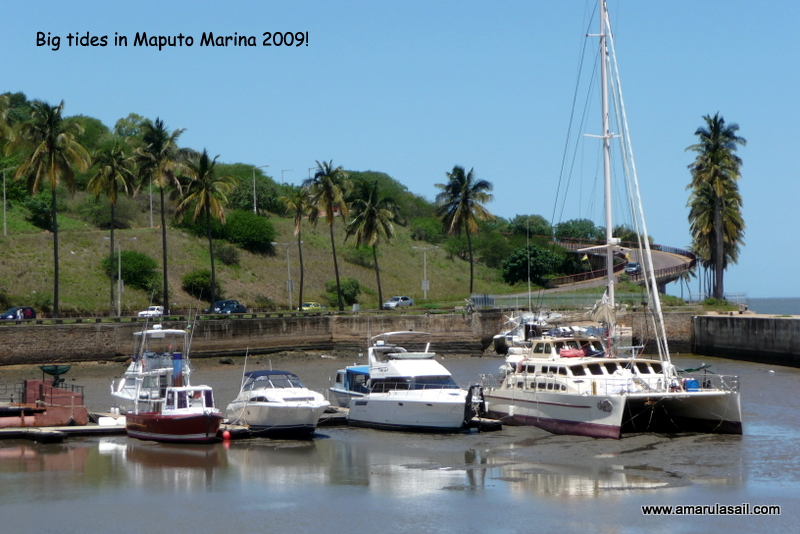
Eric (Captain - Australia) and Lynne (First Mate - England/Australia) began cruising in 2002 aboard Amarula, a 60' Crowther Catamaran hailing from Gibraltar that they build themselves.

They left Australia, cruising across the Indian Ocean to Tanzania. They stayed in Tanzania for 5 years doing charters and running a business. They visited countries along the African coast during that time. They left Tanzania for South Africa, eventually crossing the Atlantic to Brazil. They spent the next 4 years cruising up and down the Eastern Caribbean before sailing through Bonaire and Curacoa, and Columbia to Panama. After transiting the Panama Canal, they spent last season cruising across the Pacific to Fiji where they are currently.

They say: "We met in Dar es Salaam in 1993 where Eric was operating his prawn trawler (designed, built and owner operated) and Lynne went to teach at the International School of Tanganyika. Eric's dream had always been to build a yacht and sail around the world, to which Lynne responded "I'll be your crew!

We built our catamaran and launched her in July 2001 on the Clarence River, NSW, Australia. After a shake down cruise to Sydney for New Year & the fireworks, we set sail from Yamba, NSW in April 2002 around to Darwin, from where we began our circumnavigation in May 2002. We are still - very slowly - making our way around the world!"

You can learn more about their cruise on their website.

Having cruised both the Atlantic and the Pacific, how do they compare? 

We have cruised the Indian Ocean, the Atlantic and the Pacific. There is little comparison for me (Lynne), as the Indian Ocean was my first experience of an ocean crossing back in 2002. There were 5 of us onboard and we took 2 months from Darwin to Dar es Salaam, with a few short stops en route at Cocos Keeling, Chagos and Seychelles. We were on a mission to get back to Dar es Salaam, where we already had a few charter bookings lined up. But I LOVED being out on the open ocean, especially at night on my own in the wheelhouse or sitting out on deck enjoying the moon and the stars and complete serenity. We were fortunate with the weather! In fact, we motored miles north of our rhumbline looking for wind and at times just enjoyed floating at sea, swimming in the middle of the ocean thousands of miles away from anywhere.

We crossed the Atlantic from Walvis Bay, Namibia to Cabadelo, Brazil via a 6 day stopover in St. Helena in February/ March 2012. This time our only crew was our 2 Jack Russells, who did extremely well on their first ocean passage. We generally had reasonable winds and enjoyed a mostly downwind sail, thankfully avoiding the doldrums that a number of our fellow passage-makers 100 or so miles north of us lamented about daily on the morning radio net. We easily got into the groove of the passage and had no major dramas, but boy oh boy were the dogs happy when we finally made landfall in Brazil after 28 days at sea!

Meanwhile our Pacific crossing was easily the most challenging, perhaps because it is the most recent of our ocean crossings. We had an extra crew member, which especially helped with the night watches, but the first part of the sail towards the equator and the Galapagos was painfully slow. The grib files showed wind to the south of us and every time we started sailing towards it, it shifted further south. Remembering our Indian Ocean passage and the many hours of motoring, still failing to find the elusive wind, we spent some days just drifting and playing water frisbee with the dogs! As we struggled with either no wind or heavy squalls we were receiving emails from friends less than 100 miles south of us who were having a fantastic sail averaging 7 knots! Unfortunately, when we finally did get some wind the mainsheet block failed through crevice corrosion resulting in a ripped mainsail, then a few days later the block on our spinnaker snapped and our brand new spinnaker came tumbling down. This left us down to our 2 trusty headsails and we still had over 2000 miles to sail...... Add to this an almost complete lack of fish (4 in total in a 5 week passage!) and I can safely say we were all ready to set foot on land in the Marquesas!

Another thing we have noticed in the Pacific is that the weather forecasts have been invariably wrong and the winds have almost always been stronger than predicted, often from a completely different direction (see the answer below on danger)

Share a piece of cruising etiquette    

Maintain a good look out at all times and keep your radio on. Be ready to assist fellow cruisers and seafarers. We often came across fishermen as we cruised the Tanzania coastline who needed some kind of assistance, such as a tow due to broken outboard motors etc. On one occasion when we were heading to southern Tanzania for a bathymetric survey to study the reefs around Songo Songo island as part of the environmental impact study for the gas pipeline project, we stopped at Okuza island for a walk. We came across a huddled group of fishermen whose livelihood was catching and drying octopus. We soon discovered that they were stranded without water, as their supply boat hadn't shown up. As we had a watermaker onboard we offered to fill some jerry cans for them and immediately they came running over with at least 20x20 litre drums! We gave them over 200 litres of water and took one of them to the next island south where he was able to get further assistance. More recently, here in Fiji, a cruiser had run onto a reef and put out a Mayday call. We were about 5NM away at the time and changed course so we could assist.

What piece(s) of gear would you leave on the dock next time? Why? 

Because we built our catamaran for chartering we were talked into installing a dishwasher and a bar fridge, neither of which we ever used, so they became storage areas and we eventually gave them away in Africa and built in some large storage drawers instead. When we had a charter and wanted cold drinks we kept them in a cooler box on deck with ice blocks which we rotated from our freezer. As we had been based for a number of years in Tanzania prior to building the boat, we built Amarula as a stand-alone operation to operate as a charter vessel.

With the benefit of hindsight, what are the boat selection criteria you would use to purchase a boat for long term cruising?  

Eric: Max. 45'. Priority of importance: 2 oversize anchors with minimum 100 metres chain and good anchor winch plus extra rode, robust auto helm, fish finder with portable hand-held depth sounder (Hondex PS-7), plenty of solar and wind to run large fridge/ freezer, good sail wardrobe (including headsail, staysail, mainsail, code zero/ spinnaker), enclosed cockpit/ wheelhouse for comfortable cruising in all weather, good stowage, Hard bottom dinghy with mimimum 9.8HP for river and reef exploration trips.

What type of watch schedule do you normally use while offshore? 

With just 2 of us we tend to do 3 - 4 hour watches usually starting around 1900 - 2300 (Lynne), 2300 - 0300 (Eric), 0300 - 0600 (Lynne), 0600 ~ (Eric). On the few occasions where we have had extra crew on long passages we do 3 hour watches.

Have you ever felt in danger and if so, what was the source?  

On passage we have generally picked our weather windows well and been fortunate to have some excellent downwind runs. On a couple of occasions we have run into unpleasant squalls of 40+ knots or so. For example, despite all the forecasts showing light winds from the NW we hit 40 knot squalls from the SE when we were heading from the Marquesas to the Tuamotus in French Polynesia and had to heave to for a few hours - our first time ever. Back in 2002 we did a marine research charter to Aldabra and Cosmoledo islands in the Seychelles and we found ourselves sailing/ motoring head on into the first named cyclone to form above 10 degrees south and we took a battering. Unfortunately, we didn't have the luxury of being in a position to plan this passage, as this was a commercial charter that we had committed to. It also demonstrates the importance of timing your passages.

As for other kinds of dangers, when we were at anchor in Taganga Bay, Colombia, in November 2015, we were unfortunately boarded by armed pirates and robbed at gun & knife point. Meanwhile, we spent many years cruising up and down the coast of East Africa without any unpleasant incidents and in fact we had some of our most memorable experiences in that region.

How much does cruising cost?    

Again, this is a question that every cruiser would have a different answer for. Some people do it on an absolute shoe string budget never eating or drinking ashore at bars and restaurants, never taking tours or hiring cars or staying in marinas, others go all out and use cruising as a way to travel from country to country and base there, then experience just about everything that country has to offer including staying in marinas, going on shore based excursions etc. When we closed off our business in Tanzania and set off cruising we had a very healthy stock market portfolio and felt ready to take on the world and see and experience each new country to the max. In our first couple of years cruising during the GFC, we lost a huge portion of our portfolio and have been shoestring cruisers ever since! However we have had many incredible experiences and have met some fantastic people.

What is a cruising tip or a trick you learned along the way?    

Go with the wind. Relax and enjoy, rather than try to rush to meet schedules and be prepared to change your plans. We also really enjoy exploring anchorages off the beaten track and especially meeting and getting to know local people.

In your own experience and your experience meeting other cruisers, what are the common reasons people stop cruising?    

There are so many reasons. Probably the most common being age/ health/ mobility issues, finances, time for a new challenge, end of a circumnavigation and grandchildren coming along! One thing we have noticed is that many cruisers go on to become land cruisers. Perhaps we will in the not too distant future...... But one idea that we are tossing around, now that we're almost done with cruising and much closer to home is to offer 'educational retreats' onboard for wannabe/ soon to be offshore cruisers - a kind of 'try before you buy' situation where people can come and test out the lifestyle, ask questions, learn the ropes so to speak - we'd love to hear from anyone who may be keen to try something like this and we can be contacted via our website.

What question do you wish I would have asked you besides the ones I've asked you and how would you answer it?

Eric: Would you circumnavigate again? Yes!

Lynne: Would you like to continue living this lifestyle? Absolutely! 

21 August 2017

10 Questions for Tranquility Bay

Scott, Kimberly and their ship cat Allie have been cruising since 2005 aboard SV Tranquility Bay, a 38' aluminum Groupe Finot Reve d'Antilles hailing out of Detroit, MI, USA. They have spent the last twelve years sailing up and down the east coast of America and throughout the Caribbean.

They say: "From the glass towers of NYC to the steamy jungles of the Banana Republics, we've been pondering escapism and searching for a more connected and meaningful way of life.

You can learn more about their cruise at their website and their YouTube channel.

Tell me your favorite thing and your least favorite thing about your boat

We take it for granted that our boat is incredibly strong. It always brings us feelings of security when the going gets rough. Something that appeals to us more regularly, however, is it's uniqueness. A lot of people – especially in the States – don't know what to make of it. It may as well be a spaceship with its unpainted aluminum topsides and bubble. People are usually very surprised when they come inside and settle into its cozy wood interior.

Our least favorite thing about our boat is that it is often difficult to go unnoticed. Its rugged fishing boat-like appearance has always appealed to us because in our minds it has a simple look, and not a yachty one. When we arrived in Panama, however, where most of the indigenous population paddles dugout canoes, it was hard to ignore the frequent amazement of many of the locals. They pound on the side grinning and say, “Aluminio!” Then they chuckle about scrap prices and the equivalent amount of recycled cans that they'd have to collect to make as much money as they could get by cutting off a chunk of our hull. Sometimes they make us nervous.

What is the next piece of gear you would add to your boat if it were free?

We'd love to have a set of lithium batteries. They're so light weight and put out so much juice. It would be a huge boon to our cruising comfort and if we ever ended up shipwrecked, we'd be carrying our own extensive prescription for depression. However, considering that lithium is a limited resource and witnessing the roadblocks faced by the electric car industry, we don't have fuzzy feelings about any big changes coming soon. But we'd sell our soul for a set of those babies! (hello sponsors?)

In your experience, how often do you think cruisers spend sailing vs. motoring, coastally vs. on passage?

The percentage of motoring vs. actual sailing is hard to know, but what we certainly can say from our own experience is that there is a lot of impatience in the world. If you've just abandoned a thirty-year mortgage or walked away from an unfulfilling career and hopped aboard a sailboat, it can be hard to restrain your excitement. The wind isn't blowing, but you're anxious for the 'real' adventure to begin so you crank up the iron genny and head off, despite a forecast of glassy calm. Or in our own case, you start out making the mistake of jumping at the first stormy opportunity, puff out your chest and call yourselves 'real' sailors. Then you take a severe beating, and spend the next week shore-side looking for parts to replace everything you broke.

We see a lot of people out here trying to girdle the globe during one year sabbaticals. We also see lots of retirees deep into the final chapter of their lives – frequently complaining about there being “too much wind this year.” Of course people that have been out traveling longer tend to be tuned in closer to Mother Nature's frequencies, but really, the true percentages of sailing/motoring are all over the map. I don't think there is a science or study to accurately describe what percentage at any given time choose to motor or sail. Maybe chaos theory?

Spending days on end deafened by a throbbing engine, and enveloped in a cloud of soot isn't so magical. On the other hand, beating your brains back and forth and not making it into an anchorage before dark just to lay claim to some kind of sailing prowess certainly isn't smart either. Everybody wants to paint the perfect picture of their sail through paradise, but sometimes, you just have to eat it – with torn sails or a bruised ego. So … .. . 50/50???

What do you dislike about cruising that surprised you?

There is always a lot of talk about the cruising community. The number of people actually going someplace in their boats is probably equivalent to the population of a small town, so it seems like a fitting analogy. It's remarkable how often we cross paths with the same people flitting about on sailboats.

We've had friends on boats deliver generous loads of medical and school supplies to third world villages. We've met crazy wandering gypsies that have told us stories about parts of the globe that we've never heard of. We've also met folks on shore that have welcomed us with open arms thanks to the many ambassadors of good will that have traveled before us. And then, there are the Hamburger Cruisers.

There are a lot of Hamburger Cruisers out here. Most of them are pretty friendly. Don't get us wrong, many of them have been wonderful to us, but it often seems that their main priority is to eat hamburgers in every country they visit. On an extended progressive dinner party, Hamburger Cruisers travel great lengths, at great expense and discomfort, seemingly, only to find their next patty. Sometimes, however, when there are no burgers to be found – things can get ugly.

What is a cruising tip or a trick you learned along the way?

Slow down and open yourself up to new experiences beyond sampling some local food and taking a tour. Ask yourself why you've signed up for this adventure. We often meet new people trying out life on a sailboat that think they're subscribing to some kind of special 'lifestyle' that they've caught a glimpse of on YouTube, but living and traveling on a boat isn't easy. It takes awhile just to get comfortable with your floating home and develop an understanding for how things work.

We've lost count of the number of times we've met cruisers committed to crazy accelerated plans – things like two year circumnavigations. They often have scarcely enough time to even say hello, much less keep their boat together before rushing off to the next spot. From what we've seen, it's a horrible way to see the world. What is the sense of traveling thousands of miles at great expense and a snails pace, only to do a waterfall tour and head off to the next place?

In your own experience and your experience meeting other cruisers, what are the common reasons people stop cruising?

Probably the most common reason we find people bailing out early is that they've discovered traveling by sailboat was much more difficult and uncomfortable than they had imagined. It never occurred to them what it might feel like to get beat up for days on end. It continuously amazes us how many people – young and old – we watch head out for the first time after lengthy preparation, only to call it quits after they've had their first rough experience. Old age, and difficulties coping with the simple drudgery of operating a boat and living on it is another reason. Sometimes, the missus just wants to be with her grandchildren.

Where was your favorite place to visit and why?

It's hard to pin down one place, but we do have fond memories of our time in Venezuela. We entered the country shortly after their president called ours the devil. Despite some positive reports we heard before departing Grenada, we had reservations. More than one couple tried to convince us that “Hugo Chaves will confiscate your boat.” While we thought this was foolish, we did debate flying a Canadian flag to save face. Later, we thought that was foolish as well.

The Venezuelans were some of the friendliest people we've met in our travels, and the diverse scenery there was otherworldly. There was a serious crime problem everywhere we went, but thanks to a howling black market currency exchange, we remained somewhat blind to the dangers. Trading a personal check for a backpack full of money was unbelievably exciting. It was like living in the old Wild West.

Over the coarse of a year, we rode a towering wave of economic collapse. Fuel was thirty cents a gallon – delivered. To our surprise, in addition to discovering that Venezuela was indeed a democracy, we learned that the island of Margarita was full of top notch shopping centers where we loaded up with goods at pennies on the black market dollar. We filled shopping cart after shopping cart full of quality liquors, exotic brands of chocolate and giant wheels of cheese. Lomito, Spanish for tenderloin, cost less than ground chuck, so we ate it like hamburger.

We had a great time in Venezuela, and we've never regretted taking advantage of the economic situation there. We were even given free health care as visitors. What's most interesting, however, are people's reactions to our stories about this amazing place. We tell stories of many of our friends that still live there, and of all of the starving Venezuelans – still being crushed by the world oil economy. But the most striking response we ever get back at home is, “gas only cost thirty cents a gallon?!?!”

Over the time that you have been cruising has the world of cruising changed?

Venezuela seems to no longer be an option for cruisers. It is now the world's largest remaining oil reserve – and an economic war zone.

Cruiser rant: What is something that drives you crazy?

People that tell us, “it must be nice to live like you do.” They say it as if they themselves have somehow been cursed. It drives us crazy how people complain about their hectic lives in America. They often hear only what they want to from our stories. We fish. We swim in paradise. We drink cocktails at every sunset.

After meeting so many happy families that live in palm thatched huts with dirt floors – people that swim in the oceans, eat fresh food out of the jungle, and breathe the fresh air – it's really hard to listen attentively to some our friends or relatives complaining incessantly about the horrible complications of their material worlds.

What question do you wish I would have asked you besides the ones I've asked you and how would you answer it?

So I hear you guys have started a YouTube channel, what do you hope to achieve?

We'd like to share what we've learned in the last twelve years of our sailing experience and inspire others to follow their dreams. Currently we are completely overhauling/reconstructing our boat to outfit it for travel to colder climates. It has always been our ambition to travel to the edge of the icepack to see with our own eyes how the world is being changed. We'd like to take anyone else interested in the conversation about the future along for the ride in hopes of increasing awareness of the current situation. Come along for the ride at Sailing Tranquility Bay

31 July 2017

10 Questions for Tainui

John Vallentine cruised from 2005 until 2016 aboard SY Tainui, a Formosa 46 hailing from Mooloolaba, Australia. He had various crew, especially Maxine Maters, Ian Allan, & David Lucas.

You can read more about his cruise on his website.

Over the time that you have been cruising, has the world of cruising changed?   

Yes. The remote world is shrinking. We have always pursued remote cruising grounds, preferably in high latitudes where they can still be found.

Follow-up question: Any examples of the remote world shrinking?

The Galapagos, Lord Howe Island, Trinidad, Tahiti, Marquesas and Cuba all come to mind.

In the Caribbean, I wish I'd been to the Windward Islands 50 years ago.

I don't want to give you the wrong impression though. We cruised many places in solitude - Patagonia, Haiti, Newfoundland, Labrador, Iceland, Faroe, Arctic Norway and Svalbard, virtually all of Russia, Venezuela, Colombia and Ecuador. The list is still long enough for a lifetime's sailing.

Having cruised both the Atlantic and the Pacific, how do they compare?

The Atlantic is excellent for high latitude cruising – Labrador, Iceland, Svalbard, Patagonia etc. But the equatorial milk runs are boring.

The Pacific islands are becoming quite crowded but even as late as 2015 we found empty places – Tuamotus, Niue, Beveridge etc. The sailing is grand if you are going downwind.

What is a cruising tip or a trick you learned along the way?

My favourite trick is to break my travels with trips home.  It is great to leave the boat and great to return. And you can stash the boat in cyclone holes or snow-bound ports.

In your own experience and your experience meeting other cruisers, what are the common reasons people stop cruising?

There are many reasons why people stop cruising. Boredom, aimlessness, financial distress and partnership  breakups are all common.

Cruiser rant: What is something that drives you crazy?

More than anything else, I am driven crazy by fleets of Bavaria and Beneteau charter boats – what Ian calls “Eurovision Song Contest” boats. These are worse in the Med, of course.

I am also very irritated by boats which run generators at night, boats which anchor stupidly  too close ahead of me, and those wind generators which whistle noisily.

Have you ever felt in danger and if so, what was the source?  

Not really. Perhaps in a southern Ocean gale when we were surfing under bare poles at 18 knots I felt we were on a bit of a knife edge but our Aries coped effortlessly.

What is your most common sail combination on passage?

I like having the boat pulled along by the nose. Obviates the danger of broaches and gybes.

In the high latitudes, poled out storm staysail with/without poled out yankee.

In tropical grounds, poled out #1 and genniker. Sometimes with the main as well

What piece of gear seems to break the most often?  

Our 40 year old Ford Lehman engine needed regular coddling. Sheet chafe is a constant danger which can be avoided. Sail wear and tear is inevitable.

With the benefit of hindsight, what are the boat selection criteria you would use to purchase a boat for long term cruising?

Solid, simple, seaworthy and with good sailing ability. There is no better boat than the Peterson/Formosa 46 for this.

What question do you wish I would have asked you besides the ones I've asked you and how would you answer it?

What next?

I don't have a specific answer to this, but my future will always include the sea and boats.


03 July 2017

10 Questions for Dos Libras

Tammy, Bruce, and Jezabelle the cat have been cruising since 2013 aboard Dos Libras, a 1995 Catalina Morgan 45 hailing from Corpus Christi, TX, USA. They traveled down the ICW to the Gulf of Mexico from Corpus Christi to Florida then ICW and Coastal down to the Florida Keys. They turned North up the East Coast as far as Charleston, SC., then spent a season in the Bahamas.  They returned to Florida for a summer and then passed through Bahamas on their way down the Caribbean island chain.

You can read more about their cruise on their website.

They say: "We cruise very slowly.  We’ve spent the past three summers in various marinas plugged into the dock with wifi and air conditioning while doing boat projects.  We may or may not do the same this next summer down south.  

Something changed for us over this past summer in Puerto Rico.  Before then we have always felt “compelled” to be on our way to somewhere/  It is difficult to explain but while in Puerto Rico, we realised that we had no real plan until late in the summer and even then it was just to amble slowly down the Eastern Caribbean chain and then decide.  

Bruce is not getting any younger and the stresses of keeping up with the maintenance and repairs is beginning to wear on him.  At this point we may be looking for a place to stop moving and spend a longer period… but…no plans to return to the US!"


What is something that you read or heard about cruising, that you didn't find to be true? 

I did a lot of research prior to leaving home and found many sources of information.  Gradually over time I have realised that much of the negative information and warnings provided by others has been exaggerated.  Warnings about areas where current is an issue, warnings about shallow waters, warnings about passes or entrances that are tricky. I don’t know if we have just been lucky, or if our skill level is perhaps more developed than the authors of those warnings… but we have taken our boat into places that are supposed to be difficult, with little or no difficulty at all.  That is not to say that a healthy amount of caution is a bad thing. We all have to know our own skill level and what our boat will do, but just don’t be put off completely by what you read. Dig deeper and take current conditions into consideration when making your decision.  You just might miss someplace wonderful if you’re too easily put off.

Finish this sentence “One thing I’ve learned about passage planning is…”  

I have to laugh at this question.  We cruise so slowly and stay so long in some places that we’ve almost forgotten how to plan for passages.  What I consider to be a passage is anything that will require us to establish a watch schedule.  We have found that for the two of us, a two hour watch schedule works best.  It is short enough that we don’t become fatigued, and after the initial sleep, it seems that we are able to fall asleep quickly enough to get a good rest.  I always make brownies or cookies and prepare some pasta salad that is easy to serve and has lots of goodies in it.  I’ve always got my route planned out and we’ve been pretty close in our estimation of the time it will take to arrive with sufficient daylight to safely navigate to our destination.  I guess that is more than one thing isn’t it?  

In your experience how often do you think cruisers spend sailing vs. motoring, coastally vs. on passage? 

We spend a lot more time motorsailing than we ever thought we would.  We always try to sail when possible, but we are not willing to let our boat speed drop below 4 knots for very long before the engine gets fired up.  We have found that the winds are often close to on-the-nose as we’ve been making our way east until now.  But I still hold onto that hope that now that we’ll be traveling in a more N/S direction, we can sail more.  A huge contributing factor that requires motorsailing is that for passages, we would rather wait for conditions that provide a more kindly sea state, which often means lighter winds.  We would rather motorsail in more flat seas than travel under sail alone in seas much over five feet.  Thus far, current has also been an issue - we’ve been traveling against it.  The majority of our longer passages have been with reefed and overtrimmed main to steady the boat, and with the engine on to help us point closer to the lay line.  

What is something about the cruising culture you like and what is something you dislike? 

I like the fact that you can make it what you wish. If you want to have bunches of friends and a full social calendar no problem.  If you want to keep to yourself and see almost no-one that’s OK too.  If I had to come up with a dislike it would be that in some of the more popular Cruiser hang-outs it is sometimes difficult to get OFF of the merry-go-round!

What is a cruising tip or a trick you learned along the way? 

Tea Tree Oil.  I used it a lot the first couple of years out. Now it seems like I find myself using less and less but I believe that is because the mildew has been killed.  I clean my ceilings and walls much less often and my towels don’t get stinky like they used to.  (I use tea tree oil in my laundry soap and in home-mixed cleaners)

What do you miss about living on land? 

Not being wet and salty when I get to where I’m going. Whenever we go ashore in the dinghy it is almost guaranteed that we will be thoroughly splashed either coming or going. Secondly I miss fast internet.  Finding a signal that is fast enough to do much blogging is a constant struggle.  I dream of fast, unlimited internet.
 
Was there anywhere you visited that you thought was overrated (not as good as you had heard)? Was there anywhere you visited that you thought was underrated (better than you had heard)? 

I have found each place we’ve been to be better than I thought it would be in some way or other.  I have a tendency to project past experiences on my expectations for the future.  I have been proven wrong time and again.  Each place is unique and completely different from how I thought it would be.  I have to remind myself of this so that we won’t skip someplace that could be wonderful!
 
Speaking just about your boat (not gear), what is one thing you wish your boat had that it doesn’t and what is one thing your boat has that you wish it didn't? 

I wish we had more deck storage lockers… but then we would have to give up some inside space, so it’s a trade-off.  I can’t really think of anything we wish our boat did not have…

What is the next piece of gear you would add to your boat if it were free?  

A new in-house generator and additional battery amp hours.  Our Fischer Panda has died and we are using portable generators.  While this is doing an adequate job, it is a lot of work for Bruce to charge up the house bank, which he has to do at least once per day, sometimes twice depending upon cloud cover. It is also difficult for us to be “that boat” in the anchorage that ruins a perfectly good sunset with a noisy generator.

What question do you wish I would have asked you besides the ones I've asked you and how would you answer it?

We’ve been asked many times why we chose to round Hispaniola to the west and cruise the southern coast of the Dominican Republic instead of following Van Sant’s instructions to do the northern coast.

We like to review all available resources and then make our own decisions as to when and where to sail.  For us, it seemed more sensible, safer and more comfortable to go the way we did at the time of year we did.  Late in the winter when the norther’s were less frequent and weaker, but still making it down as far as Hispaniola the light wind days just before the north winds arrived would provide us with easy travel east, and then when the winds turned north, the island provided protection from the high winds and waves, but we could still travel east with the north wind to carry us along on a beam reach.  Seas were very flat with the island between us and the  winds blasting off of the Atlantic ocean, so it was perfect.  We experienced none of the danger of being on the northern shore with fewer safe anchorages and much higher seas.

The Mona Passage also seems more benign further south and we had a shorter passage than the northern route.  The timing was much easier without having to worry about the hourglass shoals. Plus the storms that roll off of Puerto Rico don’t affect the southern Mona as much.  I don’t know why anyone would ever choose that route over the one we took.  Note:  It can be a very different experience at a different time of year.  We had help with late season northers.

10 October 2011

10 Questions for Silas Crosby

sc1 Steve Millar on Silas Crosby completed a self-interview in the Newly Salted style. You can read the original interview here or the perspective of another crew member, his niece Meredith, in her interview.
------------------------
At age 56, I am in the middle of another long (metaphorical) cruise.

I started sailing at age 9 just south of Vancouver in a 9′ dinghy, then, in high I school built a 17′ catamaran and cruised the Gulf Islands of BC. My parents didn’t sail or know anything about it.

After several years of race boat crewing, I helped sail a 40′ cutter from Auckland to Vancouver over 6 months in 1974. A good taste of the South Pacific. After a hiatus of about 6 or 7 years of not much sailing, my wife and I bought a Spencer 35 named ‘Cor Leonis’ in 1986. We did an initial trip to Haida Gwaii, then took off again for a classic 3 year trip to Mexico and on to New Zealand , where our son was born.

Returning to BC via Samoa and Hawaii, in 1991, we settled in the Comox Valley, sold the Spencer 35 , had another child , and built the Brent Swain 36 steel twin-keeler, ‘Silas Crosby’ . The construction was a joint project with my brother John , and took 2 yrs and 4 months. After launching in about 1994 we cruised far and wide on the BC coast.

In 2001 the 4 of us did a north Pacific triangle cruise over a year, to Mexico, Hawaii, and home to BC again.

About a year ago in Sept 2010, we set off again to try to fulfill a long held dream., to explore the cruising grounds of the channels and islands of southern Chile and Patagonia. This time the crew was Steve (56) , my brother  (69), and niece Meredith (25). John sailed with us as far as La Paz in the Sea of Cortez before returning to Vancouver.

The idea of sailing from cold water in BC to colder water in southern Chile did not appeal to my wife Barb, so she elected to stay home and live the good life, untroubled by boat fanatics.

We are now in Valdivia, Chile, reaching the end of the austral winter. We arrived about 4 months ago via Easter Island, Galapagos, and Mexico.In the next week or two we plan to continue south eventually reaching Puerto Williams on Isla Navarino sometime around March 2012.

Tell me your favorite things about your boat.
Steel hull , twin keels , continuous tube liferails.  We pay a little bit for the twin keels when hard on the wind , but we still had a good passage from Galapagos to Easter Island with the wind forward of the beam the whole way.

The solid liferails are very sensible. I think only Amel installs them as standard on a production boat. Recommended safety item.

Tell me your least favorite thing about your boat.
Concern about rust. Not too big a problem in the first 17 years , but one does have to pay attention, despite flame-spraying during construction.

I would have loved to be able to justify the expense of a folding or feathering prop. Probably good for 1/2 knot on the wind , maybe more in light winds. The right deal has never come up in a 17 x 15″ 3- blade prop.
Of course, we need a 50′ boat to live aboard in rainy weather but only a 36′ boat to sail and pay for.

sc2 How often have you faced bad weather in your cruising? How bad?
Our worst weather was the last week coming in to Chile. We were really psyched up to get some bad weather, and would have been surprised had we not. So the two fronts that passed over us were uncomfortable, but OK.

Until that time I had used the storm jib and trysail only once before to slow down in strong winds coming in to New Zealand in 1987.

Can you think of a sailing tip (e.g., sail trim, sail combination) specific to offshore passages (e.g., related to swells)?  
This is interesting. We really use our whisker pole a lot, and try to sail wing and wing as much as possible because it is so comfortable, steady, and just generally easy on our boat.  When we arrived in Valdivia we have found several cruising boats that don’t even own a whisker pole and make their way downwind by jibing. These are all boats that have sailed thousands and thousands of miles to get here.

Another interesting thing we’ve discovered is how many crews do not keep a watch system. Many of the solo sailors just go to bed and get up whenever. Also some of the couples both turn in at bedtime and get up for breakfast. Some have AIS and radar watches but some don’t.

We tend to generally enjoy the night watches, sort of for private time.

Over the time that you have been cruising, has the world of cruising changed? 
Starting in 1974 we navigated the old, scary , approximate way. The last week coming in to Cape Scott with an RDF and DR was sketchy. GPS is excellent .We have occasionally dug out the sextant, mostly to look at it in wonder, but we don’t push the ‘off’ button on the GPS.  But really, the fundamentals have not changed at all. The people are still the same, great and friendly and helpful. The wilderness areas are still wild.
People still run up on reefs

Navigation is a lot easier, and much less stressful. That’s good.

Engines are more reliable. Sails are stronger and more durable.

What piece(s) of gear would you leave on the dock next time? Why?
We have a 10 1/2 foot Portabote, a 7 1/2 foot inflatable , two 13′ solid plastic kayaks with sprayskirts, drysuits etc, and a 2 hp outboard. We haven’t actually used either of the dinghies since sometime in Mexico. It is a lot of gear to be hauling around. I expect we will need the inflatable in Patagonia for shoreline etc.

What do you miss about living on land?
My family.

While cruising, what do you do about health & boat insurance, medical issues, banking and mail delivery?
DAN emergency health insurance and 2 yr coverage from BC government health system. I went to medical school to prepare for cruising , probably overkill (!) but it is helpful. I was offered a pre-emptive appendectomy , but declined , and brought injectable antibiotics instead.

Banking , taken care of by Herself at Home.

Mail : what mail?

Why did you decide to cruise?
Reading Slocum , then Chichester as a 10 or 12 year old.

What did you do to make your dream a reality? 
Became Obsessive.

Finish this sentence. “Generally when I am provisioning…”
I think that food (any food) is important. Also I am associated with experts in the form of Barb and Meredith.

How do you fund your cruise?
Savings.

Entering Caleta Hassler, Isla San Martin Are you attracted more to sailing itself or cruising-as-travel and has that changed over time? 
The romance of voyaging under sail in a small capable vessel to interesting and far-off lands has not faded for me in the least. Miles Smeeton was the first writer that conveyed that to me. It is the travel across oceans under sail. Sailing is important.

Where was your favorite place to visit and why?
As a general lesson, for me, when the ‘Cruising Blues’ set in, it is time to leave town. It happens more often, but not exclusively, in the cities.

I have been back to the Baja side 3 times and around Vancouver Island 6 times, so those must be my favorites.

What are some of your favorite pieces of gear on your boat and why?
After several voyages without an HF transmitter on board , I am really enjoying blabbing on the SSB and Ham nets , and on informal scheds. I find that there is still lots of time for watching the birds , the waves, and the insides of my eyelids. The 2 x 85 watt solar panels are plenty to power the radio and the little Engel fridge(also a first for us)

The crude windvane, built to an old design is invaluable.

What is the next piece of gear you would add to your boat if it were free?
Fluency in Spanish. It isn’t free, though. I has cost me many, many hours to get to the early intermediate stage.

What is a tip or a trick you have picked up along the way?
Mast Up and Water Outside. Hot tips.

How much does cruising cost?  
$17,345.43 per year, plus or minus, depending on beer.