Showing posts with label navigating. Show all posts

04 September 2017

10 Questions for Sunstone

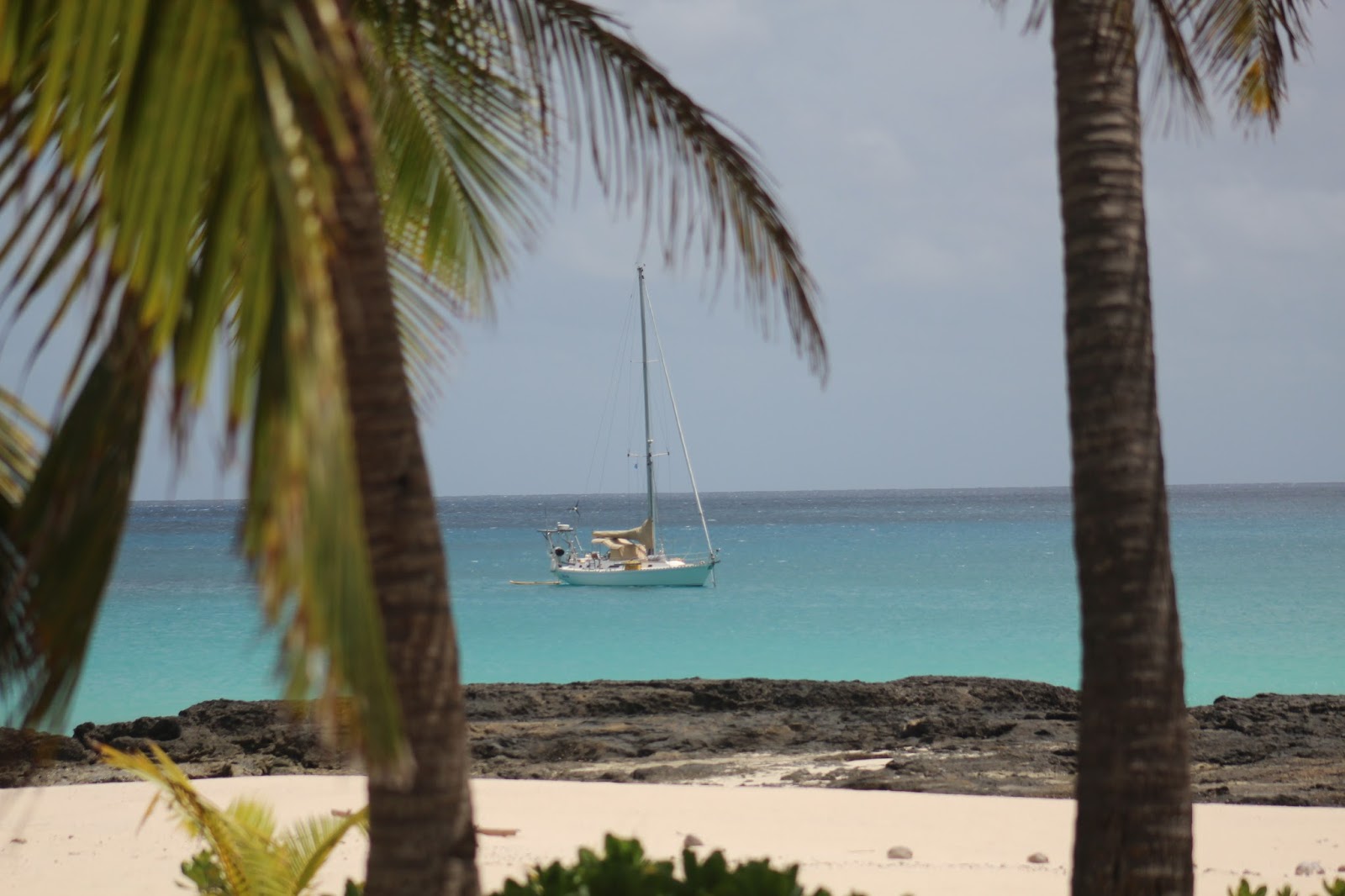
Tom and Vicky Jackson cruised from 1997 until 2015 aboard Sunstone a 1965 McGruer built, S&S designed one-off - timber-built with a varnished hull - hailing from Nelson, New Zealand.

They describe their route as "too complicated to describe generally". It goes: UK, Spain, Canaries, Caribbean, New England, Nova Scotia, ICW, Bahamas, Panama, Galapagos, French Poly, Cooks, Niue, Tonga, Fiji, NZ, Aus, New Cal, Vanuatu, Aus, NZ, French Poly, Hawaii, Alaska, Canada, USA, Mexico, Costa Rica, Ecuador, Easter Is, Chile, Falklands, Argentina, Brazil, Argentina, S. Africa, Aus, NZ, Vanuatu, New Cal, NZ, Fiji, Wallis, Tuvalu, Kosrae, Pohnpei, Guam, Japan, Aleutians, Canada, Hawaii, Samoa, NZ, Marshall Is, Aleutians, Alaska, Canada, Hawaii, Tonga, NZ. Also lots of offshore racing among the cruising, including the Bermuda Race, Sydney-Hobart, Swiftsure, Round North Island and Round New Zealand.

They say: "We did lots (about 50,000 miles) of cruising as well as offshore racing in NW Europe before we actually stopped work and left to go long-term cruising, which was in 1997. Our last long cruise ended in 2015 and we are now shore-based, but we intend to continue cruising in the South Pacific."

You can learn more about their cruise on their website or by email.

Having cruised both the Atlantic and the Pacific, how do they compare?

We don't really feel this question has a useful answer at least not in terms of significant differences or contrasts. For us a more useful comparison is between temperate and tropical or semi-tropical cruising - or perhaps between wilderness cruising and cruising in more inhabited areas. Certainly the contrast between the latter two is sharp. Wilderness cruising, whether in the Aleutians, Patagonia or the Line Islands is demanding in terms of preparation, navigation, sailing/anchoring skills and, most of all, self-reliance. In temperate zones there is also the volatility of the weather. These are in contrast to cruising in more inhabited areas, where the availability of service and support is much greater and thus the demands on cruisers generally less.

Finish this sentence “One thing I’ve learned about navigating is…” 

'The eyes have it!' Whatever electronic means you have, eyes are the most important navigating instrument you have. If things look wrong they almost certainly are, so . . . 'If in doubt, turn about.' Go back the way you came until you have worked out the right and safe course. Oh, also 'Two navigators are better than one.'

What is something you think potential cruisers are afraid about that they shouldn't fear? 

Pirates. Pirates are the muggers of the sea. They can kill you or rob you just like muggers, but there are far fewer of them and they only operate in fairly well known areas. Avoid those areas and it is very unlikely you will ever see a pirate. You are far more likely to be mugged, injured or robbed ashore somewhere.

And what is something potential cruisers don't worry about that perhaps they should? 

Having poor quality sails and not knowing how to use them! Cruisers should race. Racing teaches you not only how to make your boat go quickly in a variety of conditions, it also teaches you about boat handling under sail in conditions you might actually avoid if cruising, namely light and heavy air and tight situations with other boats. These are also necessary skills for a cruiser. Too many cruisers spend a lot of money on devices to make living aboard more like living on land - and then they skimp on sails, buying second-hand or poor quality sails. In fact, many cruisers have little understanding of what constitutes a good, well-made sail which will stand up to tens of thousands of miles of use and still have a shape which will adequately drive the boat to windward when that is essential.

Many potential and novice cruising couples do not adequately consider what demands will be made and changes will occur in their relationship to each other. Before heading off on a cruise few couples have spent 24 hours a day, every day with each other in a constantly changing and potentially risk-filled environment. In shore-based life most of us can spread our anxieties, frustrations and tantrums across a range of colleagues and friends as well as our partner. That is not the case when crossing oceans in a small boat. Achieving a complementary balance and trust in your relationship is essential and at first it may be hard work. Many apparently stable long-term relationships founder and sink under the demands of the cruising life. However, many others thrive and grow on the development of new skills, the stronger need for trust and the shared sense of achievement in the face of novelty, risk and difficulties.

What is your most common sail combination on passage? 

This depends so much on the nature of the passage that there can be no single answer. When down-wind passage-making in trade wind conditions we normally use the mainsail held with a preventer and a 125% genoa held to windward by an over-length spinnaker pole. In stable, broad reaching conditions, we often also set our inner jib (non-overlapping, but bigger and further forward than a cutter staysail) to leeward on its Solent stay. However, when the wind is forward of the beam and over 15 knots (true, not apparent) we mostly use our inner jib with any reefs which might be necessary in the main. As we do a lot of cruising in temperate waters, we use the latter configuration a good deal. As we always stand our watches on deck, fully dressed for the weather, we are able to reef early when conditions require it. We generally reef or change head-sail single-handed unless conditions are very bad. 'Sunstone' is set up to make this easy. We very rarely use our genoa part-rolled, but rather change to our jib if conditions require it.

What is something about the cruising culture you like and what is something you dislike?

We are not really aware of any one 'cruising culture'. There are many different styles of and attitudes to cruising and the different styles diverge markedly. What we look for in other cruisers whom we like and respect are curiosity, openness, friendliness, honesty and, most of all, a desire, determination and ability to be self-reliant. Though we don't condemn them for it, we are puzzled by cruisers who actually don't much like sailing and have little interest in improving their ability to sail. These tend to be the same cruisers for whom cruising is just another form of travel. They reach New Zealand, park the boat and buy a car, rather than actually cruising the country.

Tell me your favorite thing and your least favorite thing about your boat.

'Sunstone' was our home for over 30 years, so picking out one thing we particularly like about her is almost impossible. High on the list is that she takes care of us. Some boats require constant, expert attention to perform well or even keep you safe. 'Sunstone' responds to such attention, but does not require it. In conditions when we are cold, wet, tired, hungry and even a little frightened, 'Sunstone' reassures and takes care of us. This is partly the nature of her design, whose compromises have made her just about perfect for the different kinds of sailing which we have done. These include serious racing and long-term cruising as well as living aboard, while working full time at 'suit jobs' in a temperate climate. 'Sunstone' is a very sound, strongly built yacht with a sea-kindly motion, even in storm conditions.

Unfortunately, one of the compromises which makes 'Sunstone's' design so good for living aboard, her accommodation arrangement below, requires an offset companion way; this makes it impossible to mount an effective dodger which would give protection in the cockpit. Cruising on 'Sunstone' requires several very good sets of foul-weather gear as well as a tolerance for being wet and cold!

What piece of gear seems to break the most often?

No gear on 'Sunstone' breaks often!! In the last 20 years we have cruised about 150,000 miles. During that time we have only had to wait in port once for repairs (engine gear box). There are three fundamental keys to avoiding breakages: buy the best you can afford; keep it simple; maintain it. Listening to other cruisers the items which most commonly keep them in port are: gen sets, autopilots, installed refrigeration and water-makers. 'Sunstone' has none of these. The closest we come is a small camper fridge which we can do without quite happily if we have to. Otherwise, the fundamentals of engine, rig and sails can be the cause of problems. All three can be kept going by regular inspection and maintenance. Our small Yanmar engine has done 10,000 hours in 19 years without a rebuild, despite being used as our primary power generator. How often do most cruisers go aloft to inspect their rigs or replace rigging wire? In the tropics, rigging wire should probably be replaced every seven or eight years. Rigs need inspection after any heavy blow, before any long passage and then after it. Sails need regular inspection and 'a stitch in time saving nine' or more likely 100! If a piece of gear seems prone to breakage or failure, there may well be something wrong with the way it is used or its suitability for purpose. If a piece of gear is inevitably subject to constant abuse, like the heads pump, carry a spare which is always ready as a replacement.

What (if anything) do you wish someone had told you before you started cruising?

How to catch fish and how to stay warm sailing in the Bering Sea.

What do you enjoy about cruising that you didn't expect to enjoy? 

Having our faith in the fundamental goodness of human nature reinforced!

What question do you wish I would have asked you besides the ones I've asked you and how would you answer it? 

After living afloat for 35 years, we suppose that we expected to be asked (as we often are), how different it is to live ashore or how we've adapted to the change. We guess that the most fundamental answer to the latter question is that if you weren't adaptable before living afloat and cruising, that life is likely to make you adaptable. Moving ashore and buying our first house to live in after 41 years of marriage has just been another adventure - and we still feel at home when aboard 'Sunstone'.

The other bigger question is what made us start it all in the first place. Why would we choose to live first on a 31' boat and then 'Sunstone' while pursuing responsible jobs. At first the answer was easy. We couldn't afford both a boat and a house. We had to have a boat, so we didn't have a house. But there was more to it than that, because we did actually have our own version of a pre-nup: we both agreed that the only basis on which we would get married was if we lived on a boat. From the very first we agreed that if we really wanted something, we would pay the price. We wanted to go sailing as much as possible. If the price was living in cramped, damp, cold quarters with no appliances, TV, stereo, running water or shower, we would pay the price. We even decided to live that way ashore for the few years while we saved enough for our first boat. We learned to live without 'stuff'. Paying the price has got us the life we wanted. And in the circular way that all things so often work out, what we got, namely 'Sunstone', has shaped not only our sailing lives, but the whole nature of our lives together. 'Sunstone' has taught us a lot and helped us to learn about each other.
14 August 2017

10 Questions for Bella Vita

Brett & Stacey Hoopes have been cruising since 2012 aboard SV Bella Vita, a 1995 Hylas 45.5, hailing from Seattle, WA, USA.

From Seattle, they sailed down the west coast to Mexico, then across the Pacific (French Polynesia, w, both Samoas, Tonga, NZ, Fiji) then Vanuatu, New Caledonia, Australia, Indonesia and are currently in Malaysia.

You can learn about their cruise on their blog.

They say: "I worked in the boating industry for 10 years (Marketing Manager for Fisheries Supply) and Brett worked as a Sonographer at the Seattle Cancer Care Alliance before we left.  While there, Brett met and cared for many vibrant people who passed away from cancer before their time – many of who had big plans and dreams for when they retired….that they never got to do.  This strongly reinforced our decision to go cruising while we were still young enough to really enjoy it instead of waiting until we retired.  Life is short and you never know what will happen."

Tell me your favorite thing and your least favorite thing about your boat.

Bella Vita is an amazing boat – the perfect size (IOHO) and strong enough to withstand big seas.  We’ve always felt like she could handle WAY more than we can, so probably my (Stacey’s) favorite thing is how safe I feel aboard her at sea.  Brett loves how well-thought out and laid out she is.  My least favorite thing is that it doesn’t have a washing machine aboard (hope to rectify that some day!) and Brett’s is that we can’t access the anchor locker from the deck.

What is the next piece of gear you would add to your boat if it were free?

Brett:  High quality insulation around our fridge.  This has been a MAJOR issue ever since we got to warmer climates.

Stacey: A washing machine!

What is something that you read or heard about cruising, that you didn't find to be true?

Living in the USA, there is a lot of press devoted to how dangerous many parts of the globe are and how we should be concerned about traveling there – especially in Mexico.  We’ve been out now for almost 5 years and NOT ONCE have we ever felt we were in danger (other than from Mother Nature!).  We’ve been amazed by the kindness and giving nature of the majority of people we’ve met along the way.  They’ve made us feel welcome in pretty much every country we’ve visited.

What is something you think potential cruisers are afraid about that they shouldn't fear? And what is something potential cruisers don't worry about that perhaps they should?

Again – people shouldn’t fear that these places will be dangerous or that people are out to steal from them.  That’s not to say you should leave everything open and invite people to take advantage of you – but you shouldn’t waste time on the fear of the unknown when it comes to foreign lands.  What should people worry about?  THE WEATHER!  Do everything you can to learn about understanding weather forecasts and how to interpret them to aid in your routing.  The ability to know when to sit tight and when to GO is one of the most important parts of cruising successfully.  Brett adds that you should NEVER have a timeline – it will get you into trouble every single time.

Where was your favorite place to visit and why?

Suwarrow – hands down.  You can only get there by boat, and there are only the 2 park rangers that live there – so the area is completely untouched by tourism.  It was amazingly beautiful, an absolute paradise.  While some cruisers complain because you are only allowed to anchor in one area, which is open to winds and filled with coral bomies – we found that it was a little slice of heaven.  Beautiful, clear water filled with marine life, gorgeous huge manta rays, sharks, fish of all kinds and birds galore.  We spent the full 2 weeks allowed there and only wish we could have spent more time.  A close 2nd was the Tuamotos – specifically south Fakarava – which to this day had the BEST snorkeling/diving we have every experienced.

What is something about the cruising culture you like and what is something you dislike?

What we like:  The cruising culture is amazing.  Cruisers are always willing to be there for each other – to lend a hand to help fix something, to rally around a boat in dire circumstances, or to just share a beer after a hard days work.  A perfect example – while we were in Tonga our fridge stopped working and we needed new brushes.  We asked for recommendations from local cruisers on the daily net – and after the net we were contacted by a boat we didn’t know (at the time) named Iolea.  Paul and Kate just happened to also own a Hylas, and wondered did we happen to have a Grunert refrigeration system like theirs?  It turns out they had a spare set of brushes and were happy to loan them to us until we could get new ones delivered (which of course we immediately gave to them).  These two wonderful cruisers resolved our mini-crisis in a matter of hours – so fantastic!  We also love that cruisers have no qualms about visiting another boat and starting a conversation with cruisers they’ve never met….and within minutes they are likely invited aboard for a tour or a refreshment just because you’re sharing an anchorage.  How many people at home have no idea what the names of their neighbors are even though they’ve lived next to them for years?  I love the closeness and community of cruising – you really do make friends for LIFE!

What we dislike:  Watching some cruisers absolutely loose their sh!t with locals over something stupid because they expect the efficiencies of their home in a foreign land.  There is nothing more mortifying than watching a fellow cruiser (especially when they are from your home country) behave badly with the locals.  We are all ambassadors out here and should never forget to treat locals with the respect they deserve, even when things are not going to our liking.  We are guests in THEIR country and should act accordingly.

What type of watch schedule do you normally use while offshore?

During the day we don’t really have a standard schedule – whoever wants to sleep can nap as needed.  At 7pm we institute a 3/4/4/3 schedule, with me (Stacey) sleeping first.  If nothing is happening in the morning, I’ll let Brett sleep until he wakes up naturally.  If one of us hasn’t slept well (up during their offwatch time for sail changes, etc.) we make a concerted effort to get that person the rest they need during the day.  It’s important that we are BOTH functioning as well as possible, so we’ve found this works great for us – but every couple we’ve met is different.  During rough weather we often shorten up the duration as 4 hours on can be exhausting in really bad weather.  When you first start out it’s important to experiment and find out what works best for you and your partner.

Are you attracted more to sailing itself or cruising-as-travel and has that changed over time?

While we both love to sail – we definitely are more attracted to cruising for the travel.  I’ve always loved to travel, but am not fond of flying and hate living out of a suitcase – so the idea of traveling with my home was extremely appealing.  We have loved the comfort of having our floating home when everything around us is constantly changing and unknown – for me, having that little bit that is familiar is really important when you are traveling full time.  These days I sometimes worry that we’ve become true sea gypsies and will never be content to stay in one place for a long time ever again.  I guess time will tell, but as long as we can make the money last we will continue this life for as long as we possible!

Finish this sentence “One thing I’ve learned about navigating is…”

Never trust your charts.  Always keep an active watch near land and assume your charts can be as much as a ¼ mile off.  While our charts (Navionics on our RayMarine system) have been exceptionally accurate in most places, there have been exceptions and it’s imperative to use dead reckoning and all the information you have at hand in conjunction with what the charts are telling you.  We also augment our charts with a program called Ovitalmap on our iPad that allows you to download Google Earth images for offline use.  It has saved our bacon more than once and is brilliant when you are cruising in areas where there are no charts at all.

What question do you wish I would have asked you besides the ones I've asked you and how would you answer it?

How has cruising changed you?

When we first left, we were completely caught up with the rush, rush, rush of city living.  Time just continually flies by and before you know it another year has clicked by and nothing has really changed.  But when you cruise, one of the best parts is living a slower life that is less about acquiring things, and more about acquiring experiences.  It brings home the fact that the people you meet and the experiences you have with them is what life is really about.  Life is nothing without love and learning – about confronting your own personal fears and moving past them, while constantly challenging your personal “safety zones”.  Cruising has made us more patient and less judgmental – more understanding of adversity and how it can change people for the worse or for the better.

I think it took us a good 6 months to really start slowing down and accepting the slower pace of our new life.  Having time back – to be completely in control of our own time and how we use it has been a wonderful gift.  Being able to see the world on a small budget is amazing – something I never even knew was possible until we started cruising.  Now that we’ve slowed down and seen so many different places, experienced so many different cultures, we’ve really begun to understand how similar we all really are at our core.  We’ve seen some amazing things and completely different cultures – but at the end of the day the people we’ve met all have the same basic needs and (for the most part) the same values.  They show pride in their country, love for their families, frustration with their governments, they want the ability to feed and raise their families in a safe environment, and they experience all the same feelings and frustrations we’ve experienced while living in the United States.  What used to seem so amazingly different is actually almost exactly the same, no matter what the culture or religion dictates.  If we  could just get people who haven’t traveled to understand that, what an amazing world we would live in. 

17 July 2017

10 Questions for Impi

Brent Grimbeek and Ana Hill began cruising in 2011 aboard SV Impi, a Lagoon 440.

They have cruised Cape Town to Brazil, Tobago, Grenada, Lesser Antilles, British Virgin Islands, Turks and Caicos, Bahamas, Florida, Cuba, Jamaica, Panama, Galapagos, French Polynesia, Samoa, Tonga, Fiji, Vanuatu, New Caledonia, New Zealand, New Caledonia, and on to Australia

You can learn more about their cruise on their blog, through their videos, or their Facebook page.

What is something you think potential cruisers are afraid about that they shouldn't fear? And what is something potential cruisers don't worry about that perhaps they should?

A lot of people we speak to have experience of sailing in the proximity of the coast and are fearful of sailing out of the sight of land. In fact, ocean sailing is way easier and safer than coastal sailing.

A lot of potential cruisers think that all they need is the money to buy a boat and that afterwards you just need money for food and diesel.  Few wannabe cruisers realize the costs of maintenance on a boat and/or have the skills to do good maintenance themselves.

This can result in boats gradually going down hill, becoming unsafe and unseaworthy.

What do you think is a common cruising myth?  

That you are free as the wind!  Unfortunately, the way the world is nowadays we are dependent on banks as one is not allowed to carry cash in excess of 10000 of the currency of the country you enter into without doing a declaration thereof.

In many countries although not in Australia and New Zealand, having a bank account is dependent on having a proof of residential address.  This can become complex once one leaves the home country and maybe lets or sells one’s house.

Finish this sentence “One thing I’ve learned about navigating is ... that charts in many territories are inaccurate.  This requires us to use satellite photography as to avoid reefs and coral.

We were fortunate to learn this technique in French Polynesia from some fellow cruisers.  It enabled us to navigate through the Tuamotu Islands without any hiccups as we could clearly mark and identify coral heads.  Similarly charts are very inaccurate in Fiji and sailing from Vanua Levu to the Lau group overnight we were confident that we would not hit a reef as we planned our course very carefully using satellite photos.

Whilst at anchor in the darkest night we can be confident that when the wind changes we are not going to hit any rocks as our boat position can be easily monitored on the satellite photos.

With the benefit of hindsight, what are the boat selection criteria you would use to purchase a boat for long term cruising?

Buy a safe boat that is reasonably fast on the ocean and comfortable at anchor. Equip your boat in your home country and not once you are underway.  For us South Africa was a good country to do this with skilled technicians and affordable prices.

So why do we love our Lagoon?  Well it is a very safe boat, the underside ‘nacelle’ – a large bullnose protruding between the hulls toward the trampoline area tapers, as what I can only describe as a ‘third suspended hull’ – do not think Lagoon build this in as a beautiful looking feature, for it certainly is not – it is undersold and holds a phenomenal ‘secret’ to safety at sea. Let me explain.

We were sailing around the southern tip of South Africa when a storm descended upon us. The waves were breaking to the extent that the surface became filled with foam and soon we were dropping down these colossal monsters doing 17 knots bare poles. Every other catamaran there had to head out to sea, since dropping down these waves would see the bows dig into the back of the wave ahead and they feared pitch poling. Impi was the only boat to successfully round the Cape that day for shelter in the anchorage – why?

We soon learned the magic trick of Lagoon. As the bows descended into the wave ahead, that ‘bull nose’ of the nacelle would make contact with the water surface driving the bows upward, time and time again. The suspended hull effect would assist with keeping the boat steering straight down the wave, where catamaran skippers fear the boat broad siding down a wave face. This feature alone ticked a huge box for us, a major point of safety that was going to prove to be invaluable in some pretty ferocious storms we would encounter crossing many oceans of the world.

In the catamaran sailing community, we often hear sailors measuring the success of a boat by the height of bridge deck clearance – ‘the higher the better’, they would say. This is the clearance or height from the surface of the water to the underside of the boat between the hulls. Now whilst a certain amount of height helps in lighter weather conditions, many sailors do not realize that in heavier sea state conditions, too much height has a negative effect in that the wave energy under the boat gathers more momentum before hitting the underside of the bridge deck. Too little clearance is also not good as the boat can feel unstable, but in our opinion, Lagoon have cleverly found the sweet spot between.

Another incredible attribute to the Lagoon 440 is how the boat sails on different points of sail. The Lagoon 440 surprises so many fellow sailors and especially mono-hull sailors, who do not want to believe a catamaran can sail past them to their windward side, on a close ‘point of sail’. Yes, thanks to the two shorter spreaders on the mast, the Lagoon 440 sails very well upwind since the leech of the genoa can be hauled in closer before being obstructed by the spreader tips. This feature, together with the genoa car tracks, that are positioned closer to midship than many other models of catamarans makes the Lagoon 440 a terrific boat for sailing close hauled. In fact, the Lagoon sails well on all points of sail when using a variety of sails along with a barber hauler configuration for wind astern of the beam.

We can store an asymmetric sail, spinnaker, storm sail and extra genoa with ease and all concealed below the deck in lockers and not stored inside the living area of the boat.

When it comes to speed, of course the Lagoon is not a racing boat as ours is loaded with all sorts of home comforts, but it moves on average 150 to 240 nautical miles per 24 hours depending on the winds, currents and the sails rigged. For example, our previous passage from New Caledonia to Australia was an easy 4 day passage.

The Lagoon 440 leaves the factory at around 12.5 tons, but loaded weighs 16 to 17 tons depending on water and diesel on board.

Of course speed is great while sailing, however, for us arrivals and the time spent at our destination are more important. We arrive with our boat clean, all salt washed with fresh water from our 900-liter water tank and 12V water maker that produces around 60 liters per hour for the 20amps that drive it.
The solar input via our 5 Kyocera 135w each panels (675w total) sees us topping up the batteries, up to 50 Amps, and plenty enough to run the Spectra Newport MKII.

Arrival also sees us with all washing clean, dried and ironed with our normal household ‘6kg washer dryer’ fitted into an outside cabinet, next to a sink and cockpit fridge.

Inside the boat, our fridge may be nearing empty but the freezer will often be loaded with fish caught en route.  Thanks to the outside basin, those can be cleaned and filleted outside, a very clever and well thought through feature by the Lagoon designers who make Impi as close to a home on the ocean as one can get.

As soon as we are cleared, we are ready to explore the delights of islands unlike some of our co-cruisers who are hunting around for laundries, water, and electricity and stay stuck in marinas for days, sometimes weeks on end.  Usually a one-day turn around is all Impi needs before heading out to those ‘paradise like anchorages’.  With 80 meters of 13 mm chain, 20 meter of rope and a 33 kg Rocna anchor, a Delta stern anchor with 20 meters of chain, we can anchor just about anywhere, and the Lagoon carries the weight with ease.

Our Lagoon 440 has enough space for all our dive gear, dive compressor, the heavy dinghy with its 30 HP engine which the davits carry comfortably, makes it a breeze to immediately be exploring those delightful underwater corals.

Of course it all comes down to preference and what one wants to get out of a boat – for us it is more about a home which has the ability to carry all the home comforts safely and at fair speed from one destination to the next.

We live for extended times on anchor and our air conditioning, heating and refrigeration facilities ensure that we make plenty of friends!  It is not unusual to hear:  “Let’s all meet on Impi, because they have space to seat 10 round the table, enough plates and cutlery, air conditioning and a lot of space to store cold beers!”

Lagoons are sturdy boats developed not just for a charter market, they are usually baptized in rough seas - they need to cross the Bay of Biscay on their maiden run and that sea can get seriously upset with tremendous wave action as it is very shallow.

Our patio is similar to that of a mono hull turned side ways, protecting us from large waves from the stern.  In extreme weather conditions, catamarans should not as a rule, be pointed toward the weather as one would in a mono-hull.  Well, for the odd wave that may escape and descend on the boat, we do love the high back of the Lagoon 440, which provides some protection from a wave otherwise finding the aft door into the saloon.

The bridge, a feature seldom found on any other brand for a 45 foot catamaran, gives excellent visibility when cruising through reef-infested waters and is always the place our guests spend most of their time when cruising the islands.  In bad weather it is comforting to be up there as one can feel the wind and the ocean away from the noise below and inside. It brings a new perspective and certain control in what otherwise one perceives to be life-threatening conditions. It is also the area where with wind from astern, we would sleep during crossings wearing our life jacket and harness, mostly because the motion is less aggressive up there.

Another feature we loved about the Lagoon when shopping for catamarans, is the strength and thickness of the ‘fiberglass ‘ – the coach roof is solid and sturdy. It feels safe and offers living room upstairs, something much needed when sailing for years on end.

We do believe the Lagoon 440 is a terrific deep ocean sailing catamaran - we have never regretted our choice of boat to circumnavigate, the boat keeps amazing us.

How did you gain offshore experience prior to leaving?  

We studied for our captain’s license in South Africa with a private tutor who accompanied us on our first long ocean crossing from Cape Town to Brazil.  We have sailed just the two of us ever since.  Our tutor taught us a lot about sail rigging and trimming.  We did our first crossing using 2 genoas most of the time or an asymmetric sail.  Our top speed was 21 knots.  That was a bit too scary! We took 21 days to sail from Cape Town to Fortaleza. You can read about our first sailing experience on Amazon kindle – Atlantic Crossing in 21 days.

Describe a drool-worthy perfect cruising moment

Difficult question as there have been many, so maybe I must go back to the first one, which was in Northern Brazil.

We went into uncharted territory there! With only a vague description from a Brazilian sailor, we headed for Lencois Maranhenses, a national park.  It was described to us as a desert with freshwater lakes.

To get there we cruised for several hours up a muddy river with a 6-meter tidal range. We both started doubting the intelligence of doing this, as there were no other yachts around, just a lot of local fishing craft.  We had been warned that not all of these people were friendly!

We anchored out in the river at night and the next morning took the dinghy further up river where we were told by our friend to anchor.  It was a place we could only reach at high tide, taking care to avoid sandbanks.

A local fisherman drew a map of the course to take to enter and as the tide went up we took Impi into a real paradise with hundreds of red ibis, flamingoes and other birds. We were astounded by fish with 4 eyes, we had never seen before and the most awesome white sand dunes and fresh lakes where cattle would come and drink.  Beautiful jangadas, the local fishing boats, with blue sails would go up and down the river bringing in the daily catch.  The people would take pictures of us, as it was so rare to see a yacht there!  They were very friendly and didn’t even speak Portuguese but an indigenous language.

What is something that you read or heard about cruising, that you found particularly accurate?

You cannot go on a charter vacation on a boat for a few weeks and say you have ‘cruised’.  I think that depending on the level of stress in your life prior to cruising it can take several years to actually shed that stress and get into a cruising lifestyle.  To find that connection with wind, weather and ocean, to open your heart to the beauty of your surroundings is something that some people never achieve.    In our modern lives our spirits get shredded and torn into multiple directions.  Cruising for us enables us to get whole again and to have that peace inside with makes us strong enough to deal with adversity and patient enough to wait for any weather window.

What is the next piece of gear you would add to your boat if it were free?

We would upgrade our solar panels to SunPower solar panels.  At this point in time these panels have the highest energy output up to 327 W.  They carry a long power and product warranty and we believe that together with our lithium batteries, which we installed earlier this year, these would significantly reduce our need for the use of a generator.

Have you ever felt in danger and if so, what was the source?   
   
We have felt in danger a few times and we have learnt from it.  One area, which is neglected in a lot of sailing courses, is teaching students how to read the weather on our planet.  We have learnt as we went along and sometimes because we got ourselves into bad situations.

One of these times was sailing from Ua Pau in the Marqueses Islands to the Tuamotu.  The weather looked good according to the GRIBS and the forecast from Meteo France, so we left together with Tempest, an Amel mono-hull, skippered by our friends Bob and Annette Pace, medical professionals from the US.

As we went into the night the benign winds picked up to over 60 knots and the previously calm seas were whipped up into 5-7 meter waves crashing on Impi’s side.  I prepared grab bags, food, meds ready in the cock pit should we need to abandon ship. We kept out a small jib and encouraged Tempest to do the same and sailed all night through vicious waves making speeds around 12 -15 knots on a small jib!.  As the day broke, we saw a Japanese ship on the AIS and contacted them. They told us not to turn back as the storm was worse behind us then in front of us.  They were such great guys, giving us a weather forecast all the way to Fakarava, which proved to be accurate.

One of the reasons we learnt, why we had not read the weather accurately was because we didn’t look at the 500HP layer, we had just looked at the surface weather. What can happen is that the top layer breaks through to the surface given the right conditions.  You then can end up with a rapidly deepening low and cyclone strength winds.  We have learnt to always look at the top layer structure now as to avoid putting ourselves in that position again.

What question do you wish I would have asked you besides the ones I've asked you and how would you answer it?

We volunteer for an animal welfare charity Bien Naitre Animal in New Caledonia and encourage cruisers, friends and followers to become members of this charity as to set up a mobile veterinary clinic in the outer islands of New Caledonia, a service which currently does not exist.  We are grateful to the Down Under Rally Go East for their contribution to the fund. Watch our video on Moose, the abandoned island dog.

05 June 2017

10 Questions for Banyan

David MacDonald & Alexandra Palcic began cruising in 2012 aboard SV Banyan, a 2001 Jeanneau 40 Sun Odyssey hailing from Halifax, Nova Scotia, Canada.

They describe their sailing route as: "South from Nova Scotia, all the way! On the serious side though, we sailed away from our home port of Halifax in July 2012. Navigating the coast and crossing from Shelbourne to Bar Harbour (ME). We then followed the Eastern Seaboard southwards. January of 2013 had us making the “big” crossing, from NoName Harbour (Fl) to Bimini (Bahamas) where we spent two months basking in gin clear waters and beautiful beaches. In March, two back to back cold fronts appeared and we used this perfect weather window to sail from Georgetown towards Puerto Rico (via two stops, one night at Mayaguana, Bahamas, and two nights at Ocean World, Puerto Plata D.R.) The trip was all about downwind Sailing, with our spinnaker flying, wow! 

Adventuring through the Leewards & Windwards where Grenada became our home for Hurricane Season, and for the next three years we explored these amazing Caribbean Islands, going as far South as Trinidad, and as far North as Puerto Rico. In 2015 Banyan needed some work, and we needed a change, so we pointed our bow North and followed our tracks back to the US of A. We hauled out in Florida where boat jobs took precedence, and where we toured North America on our new land yacht for H-Season. The winter of 2017 had us adventuring in the beautiful Bahamas." 

You can learn more about their cruise on their blog or Facebook page.

They say: "We got married on our boat, and named her Banyan (like the tree, but not!). So what IS a Banyan? With both of our ties to the Canadian Navy (Dave, after 33 years is now retired and nicknamed The Chief. I worked on the Civilian side of things, and am affectionately known as The Admiral). We wanted a term meaningful to both. Canadian Naval Personnel use the term “Banyan” as a break in daily routine; time to enjoy a social gathering while away from the chores of daily life at sea. Loosely it translates to  “Great Times, Great Food, with Great Shipmates (Friends)”. Something we get to enjoy often with the wonderful people we’ve met along the way."

Do you have any specific advice for couples cruising?

You mean “How do you live together in 40 feet of space, 24/7?” LOL. We get asked this a lot! Well, you have to like each other. Thoughtful and respectful communication is paramount. We each have strengths & weaknesses: sometimes one person does more, and sometimes the other person does more. At the end of the day/week/cruise it all balances out.

What is the most important attribute for successful cruising? 

Flexibility, first and foremost. Weather rules all. Patience. No schedule. Nothing is as easy as it seems. And everything always happens at once. Always.

Where was your favorite place to visit and why?

Hate this question. Our favourite place? All of them! Each place is unique and special and has somethings offer in its very own way. There is nothing like the fantastically beautiful waters of the Bahamas. Or the rugged natural beauty of Dominica. Or the culture (and food!!) of the gorgeous Martinique and Guadeloupe  But what turns ME on about a place, might turn YOU off.

The key is to explore forth, have an open mind and a smile on your face, see what happens, and create your own memories.

With the benefit of hindsight, what are the boat selection criteria you would use to purchase a boat for long term cruising?

Do your own research!! Know what type of cruising you’re going to be doing. If you get a heavy boat, which is safe and comfortable for long offshore/ocean passages, that’s great. But realize you need lots of wind to get a heavy boat moving. And heavy wind typically results in bigger seas. Which typically results in more spirited conditions. Some think they need all sorts of space and buy bigger. Bigger isn’t necessarily better, as the costs associated with extra-foot-itis increase exponentially (think dockage if you’re entering a marina that charge by the foot!). What’s your skill level? Don’t buy a fixer upper, if you can’t or hate to fix things. Know what it is that YOU’RE looking to do, with the experience YOU have, and for how long you’ll be out there for, and use your answers to go looking. And remember, no boat is perfect, it’s always a compromise.

What piece(s) of gear would you leave on the dock next time? Why? 

Nothing really. We went in as minimalists, and with time, still found we had too much. But then, there was this one thing we bought while at the Annapolis Boat Show five years ago. We saw an Air Chair (a hammock type of chair that can be hung by a halyard and allow you to swing in the wind) and thought it would be the perfect way to relax, while at anchor, in idyllic conditions. IN reality? Not so much. We gave it away this year after trying to use it twice.

What do you think is a common cruising myth?

That it’s all about great sailing, in perfect weather, and then sipping margaritas on a secluded beach somewhere. It’s harder, and more work than I thought it would be. And yet, I’m continuously gobsmacked by the rewards.

How often did you face bad weather in your cruising? How bad?  

As much as we try to analyze the weather patterns of the area where we’re leaving from AND going to, nothing is ever perfect. We’ve have gotten caught a few times. During one of our crossings we looked behind us and saw some seriously black skies coming right at us. We got caught in some heavy weather, that ripped our canvas and had us coming to anchor weather whipped and soaked, and thankfully safe. And then there were these weather spouts in the Bahamas that we had to swerve away from, with the boat in front of us almost getting hit.

And then there was the Conga Line of Storms off
St Vincent & Grenadines that had us navigating through them and around them (thank goodness for radar) and turning around twice to wait them out. That experience had my knees shaking and kissing the ground when we arrived. And then there was that time we were racing in the Carriacou Regatta, and the squalls enveloped us.

What did you miss about living on land? 

Fast and furious WiFi at my Fingertips ALL the time. My very own washer and dryer. And although I have the biggest and best bathtub in the world, sometimes I miss the power of a full on, non-stop shower with massage function on the nozzle.

Finish this sentence “One thing I’ve learned about navigating is…” 

… It’s all about adjusting the sails, all the time, because the wind rarely blows the way you want it to. And the last three miles to your anchorage/mooring ball/marina? Are always the longest, ever!

What question do you wish I would have asked you besides the ones I've asked you and how would you answer it?

Not so much a question but just musings from our personal experiences of the last five years. Whatever your dream, just do it. Don’t extinguish the wind in someone else’s dream unless you’ve sailed a mile on their tack. See you somewhere south of somewhere.


24 April 2017

10 Questions for Pitufa

Birgit, Christian and ship's cat Leeloo have been cruising since 2011 aboard Pitufa, an S&S 41 hailing from Vienna, Austria.

They quickly sailed through the Med, Atlantic, Caribbean, Panama Canal and now have been cruising for 4 years in the South Pacific.

You can read more about their voyage on their website.

How did you (or did you) gain offshore experience prior to leaving?
We had no experience at all before we bought our boat. We simply wanted to travel to remote places and a sailing boat seemed like the perfect means of transport with accommodation attached. We bought the boat in Mallorca and took her through the Med to Croatia. We had plenty of opportunity during these 3 weeks and 1.500 nm to try out our theoretical book-knowledge.

Having been in both the Atlantic and the Pacific, how do they compare?

We didn't spend much time in the Atlantic/Caribbean, but the trades seemed much more stable than in the Pacific.

Do you have any specific advice for couples cruising?

There's no general recipe, some couples need lots of space and independent activities, we are lucky and just don't grow tired of being/working with each other 24/7.

What is something you think potential cruisers are afraid about that they shouldn't fear?

Many people ask how we pass the time. Potential cruisers shouldn't be worried about getting bored on a boat--there are usually too many things on the ever growing to-do list anyway.

And what is something potential cruisers don't worry about that perhaps they should?

We see many boats with insufficient equipment. Don't set out without a proper anchor and alternative energy sources (we kept buying new solar panels during our first years).

What is something about the cruising culture you like and what is something you dislike?

We like the sense of companionship, especially in remote places neighbours help each other out with bits and pieces and of course know-how.

We dislike cruisers who think it's cool to 'live off the land' in remote places and hunt everything that's moving. Take nothing but pictures, leave nothing but footprints.

With the benefit of hindsight, what are the boat selection criteria you would use to purchase a boat for long term cruising?

We bought a sturdy, reliable aluminium boat and we're happy with our choice. With Pitufa's classic lines and tumblehome she's usually the prettiest boat in the anchorage (at least for us ;-)), but these features also give her a tendency to roll in anchorages and on downwind passages. Pitufa's heavy and slow, a longer waterline would help with the boat speed.

What piece(s) of gear would you leave on the dock next time? Why?

I can't think of anything. We carry way too much gear, but we need all of it.

Are you attracted more to sailing itself or cruising-as-travel and has that changed over time?   

We're definitely travelers. We don't enjoy sailing (and despise+avoid motoring), but it's a way of getting to a new place.

Finish this sentence “One thing I’ve learned about navigating is…”

... that sailing 'in the wrong direction' (against the prevailing trade winds) isn't as hard as most cruisers think. We sailed from Tonga back to Tahiti last year and it was quite an enjoyable trip.

What question do you wish I would have asked you besides the ones I've asked you and how would you answer it?

What are the most important pieces of equipment for you?

Our windvane, because the hydrovane steers Pitufa in all conditions without drawing any electricity.

The watermaker, because it gives us the freedom to stay in remote places as long as we want.

Our 'Bügelanker' (similar to a Rocna), because it gives us the piece of mind to sleep without the need of an anchor watch and to leave the boat unattended while exploring ashore.